It was the last inning of the championship game. The Yankees had a sizable lead, but were struggling to get the final out. Their hated rivals were trying to put together one last miracle rally. Anything to tie the game.
With runners at first and second, the lead was looking to be in doubt. There were two strikes on the hitter, though, and the Yankees had their best pitcher out there. The catcher called for a meeting on the mound.
"Splitter," said the young catcher, and just like that, he had returned to home plate.
After a deep breath, the pitch came in. A splitter it surely was, only the hitter wasn't biting. The catcher wasn't much concerned with that, though, because the runners were going on the pitch. Out of the crouch, he fired a strike to third base. The third baseman applied the tag and waited for the call.
"He's out!" The umpire cried. The runner was out by a mile.
The celebration was on. There were hugs and cheers everywhere. Overwhelmed by the turn of events, the catcher launched his mask into the air wildly, almost knocking out a teammate. It didn't matter. They had won. After a long, grueling season in the hot sun, the Yankees had proven they were the best in baseball. Nothing in the world had ever been this sweet. They were champions.
. . .
The Royals lost another game tonight. More importantly, the Royals lost another winnable game tonight. This one hurt more than usual, though.* Maybe it was the fact that they made another handful of mistakes along the way, mistakes I'd expect most decent high school teams to avoid. Maybe it was that they had very good chances in the eighth and ninth to at least tie the game, and anytime you come that close to winning and don't, it's hard not to be upset.
*It seems every other loss hurts more than usual. Or maybe this team has been losing long enough now to the point where every loss hurts more than the one before. Or, it's possible this team has been losing long enough now to the point where I've become completely delusional.
More likely, though, it's because, like in most close games in any sport, the good teams find a way to win, and well, you know the rest. The Royals, of course, found a way to lose tonight, as they usually do. They always seem to be just good enough to lose. It's the one thing they never fail to do.
It's more frustrating because after winning three of their last four, including two of three from the Cardinals over the weekend, the Royals had a real chance put a dent in the Twins' lead in the division in the next few days. And yes, they still have that opportunity, but we all know what's more likely to happen. Just as they string together a few victories, the Royals, as they are accustomed to doing, will fall into a tailspin long enough to negate any progress they've made over the last week or so. The cycle will continue, as it has - give or take - for the last two decades, until the end of the season. The Royals will never get closer than arms length to first place, and will finish somewhere near the bottom of the division.
It's killing me. That may sound silly. It is silly, because it's not really killing me. With every loss, though, a part of me, at least the side of me that loves baseball, is dying. I know I can take it for awhile. I've proven that over the last twenty years. I do not know how much more I can take, though.
I sense that most people, after reading that last sentence, will laugh and assume I'm being overdramatic. While it is likely that I'd still watch another twenty years of losing Royals baseball without blinking, the thought is sincere. Really, at what point do we, as fans, finally say enough is enough, and save ourselves the hurt? Does that point ever come? I guess I really don't know.
Anyway, for whatever reason, tonight's game stuck with me for awhile. It wasn't this game in particular, obviously, but more of a cumulative frustration. It inspired some deep thought. After I got over the natural 'what could we have done to win' thoughts, I started thinking about my relationship with the Royals. Obviously, my affiliation with the Royals makes sense because I was born and raised in Kansas City. I love Kansas City. I wondered, though, do I love the Royals?
I think I've come to realize that my true love is with baseball, not the Royals. This is not to say that I don't love the Royals. That possibility is there. But without the Royals, we still have baseball. Without baseball, there are no Kansas City Royals.
And with every mental mistake a player makes, blown lead, star player traded and so on, it becomes even harder and harder and harder to love this team. What is Yuniesky Betancourt thinking when he botches a suicide squeeze with the game on the line? What's going through Billy Butler's mind when he fails to cover a base on a blooper? What exactly does David Glass think about the seventh consecutive team he's allowed represent his organization that has absolutely no chance of winning?
Does the thought in those men's minds have anything to do with their love for baseball? How about their respect for the sport? I seriously doubt it.
See, I played this sport once, too. I was the catcher on that Yankees team that won the championship. The hated rivals were the Vipers. It was South Suburban little league baseball in south Kansas City. It was one of the greatest moments of my life.
Some of my best memories were created on those Clark Ketterman ball fields. I discovered baseball there, and it's no wonder why I'll never forget the times I had. It was my first true love. I will always love this game.
It's no mystery why my mind drifted to our championship game victory while I reflected on the Royals tonight. It's possible it would take some similar soul searching - I mean truly searching for the reasons why - in order to revive this organization.
I hope it happens sooner rather than later. My love for the Royals may be running out. My love for baseball, on the other hand, will never fade.
Showing posts with label Minnesota Twins. Show all posts
Showing posts with label Minnesota Twins. Show all posts
Wednesday, June 30, 2010

Wednesday, June 23, 2010
Royals, Twins Walk Separate Paths
As a longtime Kansas City baseball fan, I can safely say I've seen just about anything and everything you could ever dream of seeing happen on a baseball diamond.
That is except, of course, winning baseball.
In this stupor that is the last two decades of losing baseball the Royals have subjected us to, as fans, we've kind of lost touch on what's really going on. That, and we're not really sure why we're still watching.*
*Every time I DVR a Royals game, two thoughts come to mind:
And the losses pile on - it's like this team has been losing forever - without any explanation.
It's time we explored one possible explanation: The walks.
I think it's only fair that we use the Minnesota Twins as a comparison. The Twins have been winning for a full decade now, and their rise from almost being contracted to model small-market franchise is something the Royals would love to replicate.
Also, it's important to note why the Twins are a relevant comparison. It's been said there is no other one thing that has more emphasis put on it in Minnesota than the importance of their pitchers throwing strikes. From day one in development all the way to the major league level, it's something their coaches preach. Walks are like sin in the organization, and their pitchers either catch on or hit the road.
So let's start with 2010. As you might expect, as of Tuesday, the Twins are first in the majors having only given up 146 bases on balls. What's more telling is the second place team has walked 31 more hitters. The Royals, of course, are in the bottom third of the league at 23rd, with 256 BBs. That's a mere 110 more, or 1.5 more per game, than Minnesota.*
*While looking at that stat I noticed the Royals and Twins have virtually the same innings pitched and batting avg. against this season, yet KC has given up a whopping 77 more earned runs so far. Ouch.
Since 2001, when the Twins began their dominance of the A.L. Central, the team has never finished worst than fourth in least walks allowed. In that same time frame, the Royals' average ranking is 20th, and they never finished higher than ninth.
What's most staggering is since 2003, the Twins have been best in the league in walks allowed three times, and either finished first or second every season in that time period.
Now, none of all this matters unless it equates to victories, and it surely does. From '01 on, the Twins have had only one losing season, and have won the division five times. And that includes some absolute dominance of our boys in blue that most of us would like to forget.
On the other hand, our walk-happy Royals club has had one winning season and four-100 loss seasons in the last decade to show for their ignorance to this obvious deficiency. It's embarrasing.
We know this isn't the only reason the Royals have been losing. It's certainly not the only reason the Twins are winning. They have a couple of young hitters named Mauer and Morneau that have played a pretty big role in the team's recent success.
Still, it's one thing the Royals have been bad at for awhile now. It's something they'll have to drastically improve upon as they try to progress and eventually become a winning team. And certainly it's something we can all think about come October, when the Twins are still playing baseball and the Royals are not.
Source: MLB.com
That is except, of course, winning baseball.
In this stupor that is the last two decades of losing baseball the Royals have subjected us to, as fans, we've kind of lost touch on what's really going on. That, and we're not really sure why we're still watching.*
*Every time I DVR a Royals game, two thoughts come to mind:
- I hope we win tonight.
- We're not going to win tonight.
And the losses pile on - it's like this team has been losing forever - without any explanation.
It's time we explored one possible explanation: The walks.
I think it's only fair that we use the Minnesota Twins as a comparison. The Twins have been winning for a full decade now, and their rise from almost being contracted to model small-market franchise is something the Royals would love to replicate.
Also, it's important to note why the Twins are a relevant comparison. It's been said there is no other one thing that has more emphasis put on it in Minnesota than the importance of their pitchers throwing strikes. From day one in development all the way to the major league level, it's something their coaches preach. Walks are like sin in the organization, and their pitchers either catch on or hit the road.
So let's start with 2010. As you might expect, as of Tuesday, the Twins are first in the majors having only given up 146 bases on balls. What's more telling is the second place team has walked 31 more hitters. The Royals, of course, are in the bottom third of the league at 23rd, with 256 BBs. That's a mere 110 more, or 1.5 more per game, than Minnesota.*
*While looking at that stat I noticed the Royals and Twins have virtually the same innings pitched and batting avg. against this season, yet KC has given up a whopping 77 more earned runs so far. Ouch.
Since 2001, when the Twins began their dominance of the A.L. Central, the team has never finished worst than fourth in least walks allowed. In that same time frame, the Royals' average ranking is 20th, and they never finished higher than ninth.
What's most staggering is since 2003, the Twins have been best in the league in walks allowed three times, and either finished first or second every season in that time period.
Now, none of all this matters unless it equates to victories, and it surely does. From '01 on, the Twins have had only one losing season, and have won the division five times. And that includes some absolute dominance of our boys in blue that most of us would like to forget.
On the other hand, our walk-happy Royals club has had one winning season and four-100 loss seasons in the last decade to show for their ignorance to this obvious deficiency. It's embarrasing.
We know this isn't the only reason the Royals have been losing. It's certainly not the only reason the Twins are winning. They have a couple of young hitters named Mauer and Morneau that have played a pretty big role in the team's recent success.
Still, it's one thing the Royals have been bad at for awhile now. It's something they'll have to drastically improve upon as they try to progress and eventually become a winning team. And certainly it's something we can all think about come October, when the Twins are still playing baseball and the Royals are not.
Source: MLB.com
Sunday, May 9, 2010
Hillman May Be Ready to Move On
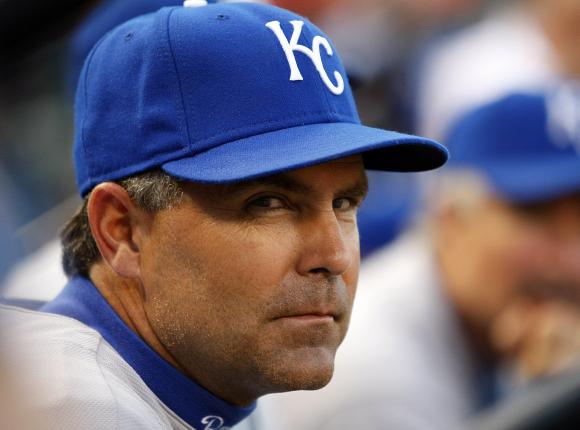
I think Trey Hillman is ready to be done. I can feel it.
The manager of the Royals looks tired. He looks confused. When his decisions are questioned, he seems to get defensive, and there's a look about him that gives you the feeling he may not really want to manage this team anymore.
Royals fans have seen this before.
The Royals just completed their longest road trip of the season, after a 6-4 loss to the Texas Rangers on Sunday. They went 3-8 on the trip, including getting swept in a four game series by Texas, and have currently lost five straight. They now find themselves, somehow, ten games under .500 at 11-21, last in the A.L. Central and 11.5 games back of the first place Minnesota Twins.
Yep. Sounds familiar.
Obviously, it's not all Hillman's fault. Not even close. The numerous bad free-agent signings made by GM Dayton Moore in the last couple of off-seasons have been well documented. The failure to develop sure-thing prospects certainly can't be blamed on the manager, either. The talent on the current major league roster is average at best.
Nevertheless, the Royals aren't average. They're not even bad. Ten games under .500 after five weeks of the season is horrendous.
Yet they're still third in the A.L. in hitting. The bullpen has somewhat seemed to settle down. Their starters are giving them a chance to win at, the very least, an average rate. So what gives?
Inevitably, yet fairly, we must look to the manager.
. . .
I found Saturday night's game versus Texas an especially frustrating one to watch.
Let's jump to the top of the seventh inning. It's a tie game. The Royals have a runner at third, two outs, and first baseman Kila Ka'aihue, getting his first start of the season, is due up. There's a lefty on the mound, and Kila is a left-handed hitter. Hillman had given Jose Guillen the night off, so he's available to pinch hit. Hillman does use Guillen as a pinch hitter, and he fails to drive the run in.
Now, if you're down by one or two runs in that situation, it seems pretty obvious to me that you send Guillen up to hit. He's your best power hitter and can tie the game or take the lead with one swing.
In a tie game though, there are many cons to that decision. Firstly, if you need a pinch hit later in the game, possibly in extra innings as the game looked to be destined for, you no longer have Guillen available. Secondly, unless you want to take Guillen's bat out of the lineup for the rest of the game, you have to put him in the field somewhere, and I can't figure anyone liking the idea of that.
Hillman chose to leave Guillen in the game and put him in right field, moving David DeJesus to left field, and moving Scott Podsednik from left field to center field. That forced Mitch Maier (who had made two spectacular plays in the game at center field already) to move to first base.
Maier, an above-average center fielder, had never played first base in a major league game before Saturday. DeJesus hadn't played left field since last season. And, of course, Guillen has proven to be worthy of the designated hitter role eternally.
Now, all the sudden, the Royals had four players (including Podsednik) who are either below average at their position or haven't played the position they're at this season - and of course, in Maier's case, any season.
The alternative to all this defensive shuffling would have been to simply use Willie Bloomquist in place of Guillen after his pinch hit at-bat, and put him at first base where Ka'aihue was playing. You then have generally your best defensive lineup in for the game's final few innings. More on that in a moment.
. . .
It's the bottom of the eighth now, and Gil Meche is easily having his best pitching performance of the season. He's already over 100 pitches, though. Given his injury history, it's a mere certainty Hillman will go to the bullpen now. Also, Meche has struggled all season, and it's important for him to leave the game on a good note.
Oddly, Hillman chooses to stay with Meche for the eighth. The first batter walks. It's the sixth free pass he's given out on the night. The camera moves to Hillman, who looks ready to walk out of the dugout and pull Meche. Usually, when managers stretch their starters this long, it only takes a baserunner to get the hook.
Instead, Hillman stays with Meche. The baserunner is caught stealing, so the decision seems to be vindicated, at least for the moment. The next batter walks. It's Meche's seventh of the game. The camera goes to Hillman, who again remains in the dugout. Two arms are ready in the bullpen if the manager needs them. Not yet, though.
The next hitter reaches on an infield single. Now there's two on and one out. The game is tied, and hot hitting Vladimir Guerrero is coming to the plate. This time Hillman comes out to talk to Meche, whose pitch count now is roughly 120. Hillman decides to stay with Meche.
Meche gets Guerrero on a fly out. There's two out now, and it's starting to look like the Royals may just get out of this jam. Meche needs one more.
 Now remember all that defensive shuffling a minute ago? This is when the decision to leave Guillen in the game (or use him as a pinch hitter at all) will come back to haunt Hillman. The next hitter, former Mizzou star Ian Kinsler, hits a line-drive to right. The ball looks catchable. The ball is catchable. Guillen runs in toward it. It looks like he can get to it. He doesn't. The ball drops, and by the replay, it looks as if it almost hit Guillen on the top of his cleats.
Royals fans collectively groan. It's probably a safe assumption that DeJesus would have gotten to the ball, but you never know. Either way, the go-ahead and eventual game-winning run scores. Another winnable game ends in a losing effort.
. . .
This is the life of the manager of the Kansas City Royals. When at a disadvantage talent-wise, the game management is under an even bigger microscope. Questionable decisions will often backfire. Worst-case scenarios become reality. The losses begin to weigh on the city and the team. Most of all, though, the losses take their toll on the manager, and there's only the next decision, next game, or next season for a chance at redemption.
It's likely the opportunity for Hillman has come and gone, and I get the sense he's okay with that.
*Thanks to firedayton.blogspot.com and Tony Gutierrez of kansascity.com for the images.
The manager of the Royals looks tired. He looks confused. When his decisions are questioned, he seems to get defensive, and there's a look about him that gives you the feeling he may not really want to manage this team anymore.
Royals fans have seen this before.
The Royals just completed their longest road trip of the season, after a 6-4 loss to the Texas Rangers on Sunday. They went 3-8 on the trip, including getting swept in a four game series by Texas, and have currently lost five straight. They now find themselves, somehow, ten games under .500 at 11-21, last in the A.L. Central and 11.5 games back of the first place Minnesota Twins.
Yep. Sounds familiar.
Obviously, it's not all Hillman's fault. Not even close. The numerous bad free-agent signings made by GM Dayton Moore in the last couple of off-seasons have been well documented. The failure to develop sure-thing prospects certainly can't be blamed on the manager, either. The talent on the current major league roster is average at best.
Nevertheless, the Royals aren't average. They're not even bad. Ten games under .500 after five weeks of the season is horrendous.
Yet they're still third in the A.L. in hitting. The bullpen has somewhat seemed to settle down. Their starters are giving them a chance to win at, the very least, an average rate. So what gives?
Inevitably, yet fairly, we must look to the manager.
. . .
I found Saturday night's game versus Texas an especially frustrating one to watch.
Let's jump to the top of the seventh inning. It's a tie game. The Royals have a runner at third, two outs, and first baseman Kila Ka'aihue, getting his first start of the season, is due up. There's a lefty on the mound, and Kila is a left-handed hitter. Hillman had given Jose Guillen the night off, so he's available to pinch hit. Hillman does use Guillen as a pinch hitter, and he fails to drive the run in.
Now, if you're down by one or two runs in that situation, it seems pretty obvious to me that you send Guillen up to hit. He's your best power hitter and can tie the game or take the lead with one swing.
In a tie game though, there are many cons to that decision. Firstly, if you need a pinch hit later in the game, possibly in extra innings as the game looked to be destined for, you no longer have Guillen available. Secondly, unless you want to take Guillen's bat out of the lineup for the rest of the game, you have to put him in the field somewhere, and I can't figure anyone liking the idea of that.
Hillman chose to leave Guillen in the game and put him in right field, moving David DeJesus to left field, and moving Scott Podsednik from left field to center field. That forced Mitch Maier (who had made two spectacular plays in the game at center field already) to move to first base.
Maier, an above-average center fielder, had never played first base in a major league game before Saturday. DeJesus hadn't played left field since last season. And, of course, Guillen has proven to be worthy of the designated hitter role eternally.
Now, all the sudden, the Royals had four players (including Podsednik) who are either below average at their position or haven't played the position they're at this season - and of course, in Maier's case, any season.
The alternative to all this defensive shuffling would have been to simply use Willie Bloomquist in place of Guillen after his pinch hit at-bat, and put him at first base where Ka'aihue was playing. You then have generally your best defensive lineup in for the game's final few innings. More on that in a moment.
. . .
It's the bottom of the eighth now, and Gil Meche is easily having his best pitching performance of the season. He's already over 100 pitches, though. Given his injury history, it's a mere certainty Hillman will go to the bullpen now. Also, Meche has struggled all season, and it's important for him to leave the game on a good note.
Oddly, Hillman chooses to stay with Meche for the eighth. The first batter walks. It's the sixth free pass he's given out on the night. The camera moves to Hillman, who looks ready to walk out of the dugout and pull Meche. Usually, when managers stretch their starters this long, it only takes a baserunner to get the hook.
Instead, Hillman stays with Meche. The baserunner is caught stealing, so the decision seems to be vindicated, at least for the moment. The next batter walks. It's Meche's seventh of the game. The camera goes to Hillman, who again remains in the dugout. Two arms are ready in the bullpen if the manager needs them. Not yet, though.
The next hitter reaches on an infield single. Now there's two on and one out. The game is tied, and hot hitting Vladimir Guerrero is coming to the plate. This time Hillman comes out to talk to Meche, whose pitch count now is roughly 120. Hillman decides to stay with Meche.
Meche gets Guerrero on a fly out. There's two out now, and it's starting to look like the Royals may just get out of this jam. Meche needs one more.
 Now remember all that defensive shuffling a minute ago? This is when the decision to leave Guillen in the game (or use him as a pinch hitter at all) will come back to haunt Hillman. The next hitter, former Mizzou star Ian Kinsler, hits a line-drive to right. The ball looks catchable. The ball is catchable. Guillen runs in toward it. It looks like he can get to it. He doesn't. The ball drops, and by the replay, it looks as if it almost hit Guillen on the top of his cleats.
Royals fans collectively groan. It's probably a safe assumption that DeJesus would have gotten to the ball, but you never know. Either way, the go-ahead and eventual game-winning run scores. Another winnable game ends in a losing effort.
. . .
This is the life of the manager of the Kansas City Royals. When at a disadvantage talent-wise, the game management is under an even bigger microscope. Questionable decisions will often backfire. Worst-case scenarios become reality. The losses begin to weigh on the city and the team. Most of all, though, the losses take their toll on the manager, and there's only the next decision, next game, or next season for a chance at redemption.
It's likely the opportunity for Hillman has come and gone, and I get the sense he's okay with that.
*Thanks to firedayton.blogspot.com and Tony Gutierrez of kansascity.com for the images.
Subscribe to:
Posts (Atom)