
Showing posts with label Kansas City Royals. Show all posts
Showing posts with label Kansas City Royals. Show all posts
Sunday, April 5, 2015
Baseball from the Heart
I've spent the better part of my Easter Sunday browsing through YouTube videos. It sparked from a friend's Facebook post linking to a recap video of the Kansas City Royals historic playoff-run last October. Have you seen how many are out there? Hundreds, seemingly. Most have the term "Blue October" in the title. Some will give you chills, maybe even produce a happy tear or two. But all of them have one thing in common... everyone's happy until the end.

Thursday, March 8, 2012
Royals, Super Fan Chris at odds after season-ticket squabble
Last December, the Royals found a way to successfully alienate the second most-recognizable player in franchise history.
So, then, it should go as no surprise that the Royals have now found a way to successfully alienate possibly its most prominent and committed season-ticket holder in franchise history.

So, then, it should go as no surprise that the Royals have now found a way to successfully alienate possibly its most prominent and committed season-ticket holder in franchise history.

Thursday, December 22, 2011
The blatantly obvious/past-due/painfully true Kansas City sports fan's Christmas wish-list
KU basketball's national championship in 2008 notwithstanding, the Kansas City sports-scene has been deprived of glory for quite some time. From the almosts and should-have-beens for the '90s Chiefs to the punchline buffoonery of the 2000s Royals, this generation of fans in Kansas City has seen just about everything there is to see ... except, of course, the team(s) they love winning it all.
Well, 'tis the season, right? I present to you:
The Blatantly obvious/past-due/painfully true Kansas City sports-fan's Christmas wish-list.

Well, 'tis the season, right? I present to you:
The Blatantly obvious/past-due/painfully true Kansas City sports-fan's Christmas wish-list.

Wednesday, December 7, 2011
White's ousting proves Royals are still clueless
The ousting of color-commentator Frank White and producer Kevin Shank from the Fox Sports Kansas City broadcast team should come as no surprise to the common Royals fan.
Instead, it should serve as a healthy reminder of just how clueless the men atop the organization still are.

Instead, it should serve as a healthy reminder of just how clueless the men atop the organization still are.

Tuesday, August 23, 2011
Are you ready? The Royals will win next year
Don't look now. The Kansas City Royals are just about ready to contend.
 ...Next year.
Shhhh. Don't jinx it!

Shhhh. Don't jinx it!
Thursday, August 4, 2011
Billy who? Meet: #CountryBreakfast
Thanks to Twitter, the Billy Butler era in Kansas City has come to an end.

Let me explain.
Wednesday, January 19, 2011
Show us a sign, Mr. Glass
Tuesday, Royals pitcher Gil Meche shocked the baseball world by announcing his retirement, thus forfeiting the last $12.4 million guaranteed to him for the final year of his five-year, $55 million contract he signed with the team back in 2007.
Now that Meche is gone, and the Royals all the sudden have their lowest payroll (by far) since GM Dayton Moore arrived, projecting somewhere in the $30 million range, the (12) million dollar question is this:

Where's that extra $12-mil going, Mr. Glass?
Now that Meche is gone, and the Royals all the sudden have their lowest payroll (by far) since GM Dayton Moore arrived, projecting somewhere in the $30 million range, the (12) million dollar question is this:

Where's that extra $12-mil going, Mr. Glass?
Monday, December 20, 2010
Greinke's gone and the cycle continues
One thing is for sure now that the Kansas City Royals have traded away their ace starting pitcher, Zack Greinke — the team is building quite the stack of chips to play with for the future.
The only problem is, the team isn't quite ready to go all-in just yet.
In fact, you could argue the Royals have already folded for 2011, and the calendar-year won't even officially begin for another two weeks.
The only problem is, the team isn't quite ready to go all-in just yet.
In fact, you could argue the Royals have already folded for 2011, and the calendar-year won't even officially begin for another two weeks.
Monday, October 4, 2010
Royals can't (or won't) stop the bleeding in 2011 and beyond
It's likely you've had more important things to do with your time than keeping up with a losing baseball team in October, so you probably didn't hear. Baseball's regular season came to a close Sunday, with our Royals falling to the postseason-bound Tampa Bay Rays 3-2 in extra innings.
The team, a shell of its former, fresh out-of-spring training, just-as-talentless self, finished the season with a 67-95 record. Our boys in blue haven't fielded an above-.500 team since 2003, and that fluky season was the lone time in the last 16 years that anything close to winning baseball has been played out at Kauffman Stadium.
It's terrible.
The team, a shell of its former, fresh out-of-spring training, just-as-talentless self, finished the season with a 67-95 record. Our boys in blue haven't fielded an above-.500 team since 2003, and that fluky season was the lone time in the last 16 years that anything close to winning baseball has been played out at Kauffman Stadium.
It's terrible.
Tuesday, August 17, 2010
Memoirs of a Misguided Sports Fan
This past weekend was a fairly interesting and eventful few days on the Kansas City sports front. The Chiefs, with their seemingly popular new rookie class, opened up their preseason schedule against the Falcons in Atlanta on Friday. Meanwhile, the struggling Royals hosted the hated New York Yankees for four games in yet another David vs. Goliath style matchup.
This is how it all looked from my vantage point..
* * *
Let's start with Friday, which, at least when the weekend began, was the day most fans in this city (including myself) were looking forward to the most. It was amazing to see how quickly the hype and excitement surrounding the Chiefs coming into this season seemed to vanish. In my previous post, I mentioned a few things to look for during the game that might help clue us in on how much this team has really improved.
Well, if we were to use that as a basis, the results are mostly mixed. Branden Albert looked okay, but the ultimate goal of him improving is to see the offensive line perform better as a whole. That did not happen, at least while the Falcons first-team defense was still in the game. In limited play, new addition Thomas Jones had little room to the run the ball between the tackles, and it wasn't until the second quarter when Jamaal Charles checked in that the running game really even got going. By then, the Atlanta starters were already out of the game, making the results less signifcant. Also, right tackle Ryan O'Callaghan whiffed on a block on the second offensive series, leading to a sack and fumble by quarterback Matt Cassel.
Cassel didn't look great at all Friday, either. His final stats (other than the fumble) may have looked up to par - six of eight for 25 yards - but you have to look deeper. During one series on third down, Cassel took a sack when he had an opportunity to throw the ball away and secure a very makeable field goal attempt. The sack led to the attempt by kicker Ryan Succop being much longer, and of course, he missed it. Playoff quarterbacks do not make those kinds of mistakes.
It was surprising to see that, at least to my knowledge, Cassel (or any of the quarterbacks) never even targeted receiver Dwayne Bowe on a pass attempt. Now, it's possible that was more of a product of conservative play-calling than anything else. Still, even in the first preseason game, it's a bad sign.
And we haven't even elaborated on the fumble play, which could have easily been avoided. The block was missed by the right tackle, which isn't a right-handed quarterback's blind side. So your guess is as good as mine as to why Cassel didn't simply step up in the pocket and roll to the outside, which he clearly had plenty of room to do, to try and make a play. Instead, he tried to rush his throw, but his arm was hit by Atlanta defensive end Kroy Biermann, and the ball was knocked loose before the tuck rule could come into play.
There were some encouraging signs to speak of Friday. Although first-round draft pick Eric Berry didn't make any big plays, he did seem to be around the ball on almost every play while he was in the game. The two second-round picks from the 2010 draft were the real stars, though. It was somewhat of a shock to see Dexter McCluster lined up as a running back more often than a receiver after the team made it clear he'd contribute primarily as a slot receiver in the offense. That didn't seem to matter one bit, though, after the ball was in his hands. It's pretty obvious to me that, if he can stay healthy, McCluster will quickly become a star in Kansas City. His quickness was absolutely unmatched by the Falcon defense as he repeatedly beat the linebackers to the outside on sweeps and pitch plays for big chunks of yardage. On the end of one run, McCluster took a big-time late hit by a Falcon defender but immediately popped back up with a smile on his face. Let's hope he can continue to do that into the regular season, when the wear and tear begins to take its toll on the players' bodies.
The other second-round pick, cornerback Javier Arenas (who is also known for his speed), shined as well. It looks like the Chiefs may have finally found a comparable replacement to Dante Hall in the return game. Arenas returned three kickoffs for 85 yards, including a 42-yarder. He also had a 99-yard kickoff return for a touchdown taken off the board because of a holding penalty called on rookie free agent Justin Cole. Not bad at all for a debut.
Overall, though, the team and its fans got a healthy dose of reality Friday. Maybe all those playoff predictions were a bit premature. Or maybe not. On the one hand, you got the feeling Friday that if the starters stayed in the game, the Falcons would have won by five touchdowns. On the other, it is preseason. Just as we may have put too much stock into a solid offseason and smooth (so far) training camp, we should apply that to our analysis of Friday's disappointment and avoid jumping to conclusions just yet.
* * *
Saturday was a change of pace, as I, for the first time since April visited Kauffman Stadium to see a Royals game.*
 It wasn't until after the game that it really dawned on me that I had just witnessed history, or something close to it. It's not every day you get to see a member of the 600-homerun club play ball, let alone blast three in one game. Obviously, in A-Roid's quest to join the elite group (there are now only seven members) there was a lot of talk about how big of a deal the 600th homerun would be, considering his use of steroids while in high school, which he admitted to a few years back.
 The practice was fairly uneventful. I was impressed with the fan turnout - my guess is the total number of spectators was easily more than half than the number of people who attended Sunday's Royals game. There weren't necessarily many plays of note. The highlight was probably watching offensive coordinator Charlie Weis move around on the rascal. I mean no disrespect to people who deal with disabilities, but an NFL coach telling 300-pound grown men what to do from the seat of his rascal is comedic gold.
This is how it all looked from my vantage point..
* * *
Let's start with Friday, which, at least when the weekend began, was the day most fans in this city (including myself) were looking forward to the most. It was amazing to see how quickly the hype and excitement surrounding the Chiefs coming into this season seemed to vanish. In my previous post, I mentioned a few things to look for during the game that might help clue us in on how much this team has really improved.
Well, if we were to use that as a basis, the results are mostly mixed. Branden Albert looked okay, but the ultimate goal of him improving is to see the offensive line perform better as a whole. That did not happen, at least while the Falcons first-team defense was still in the game. In limited play, new addition Thomas Jones had little room to the run the ball between the tackles, and it wasn't until the second quarter when Jamaal Charles checked in that the running game really even got going. By then, the Atlanta starters were already out of the game, making the results less signifcant. Also, right tackle Ryan O'Callaghan whiffed on a block on the second offensive series, leading to a sack and fumble by quarterback Matt Cassel.
Cassel didn't look great at all Friday, either. His final stats (other than the fumble) may have looked up to par - six of eight for 25 yards - but you have to look deeper. During one series on third down, Cassel took a sack when he had an opportunity to throw the ball away and secure a very makeable field goal attempt. The sack led to the attempt by kicker Ryan Succop being much longer, and of course, he missed it. Playoff quarterbacks do not make those kinds of mistakes.
It was surprising to see that, at least to my knowledge, Cassel (or any of the quarterbacks) never even targeted receiver Dwayne Bowe on a pass attempt. Now, it's possible that was more of a product of conservative play-calling than anything else. Still, even in the first preseason game, it's a bad sign.
And we haven't even elaborated on the fumble play, which could have easily been avoided. The block was missed by the right tackle, which isn't a right-handed quarterback's blind side. So your guess is as good as mine as to why Cassel didn't simply step up in the pocket and roll to the outside, which he clearly had plenty of room to do, to try and make a play. Instead, he tried to rush his throw, but his arm was hit by Atlanta defensive end Kroy Biermann, and the ball was knocked loose before the tuck rule could come into play.
There were some encouraging signs to speak of Friday. Although first-round draft pick Eric Berry didn't make any big plays, he did seem to be around the ball on almost every play while he was in the game. The two second-round picks from the 2010 draft were the real stars, though. It was somewhat of a shock to see Dexter McCluster lined up as a running back more often than a receiver after the team made it clear he'd contribute primarily as a slot receiver in the offense. That didn't seem to matter one bit, though, after the ball was in his hands. It's pretty obvious to me that, if he can stay healthy, McCluster will quickly become a star in Kansas City. His quickness was absolutely unmatched by the Falcon defense as he repeatedly beat the linebackers to the outside on sweeps and pitch plays for big chunks of yardage. On the end of one run, McCluster took a big-time late hit by a Falcon defender but immediately popped back up with a smile on his face. Let's hope he can continue to do that into the regular season, when the wear and tear begins to take its toll on the players' bodies.
The other second-round pick, cornerback Javier Arenas (who is also known for his speed), shined as well. It looks like the Chiefs may have finally found a comparable replacement to Dante Hall in the return game. Arenas returned three kickoffs for 85 yards, including a 42-yarder. He also had a 99-yard kickoff return for a touchdown taken off the board because of a holding penalty called on rookie free agent Justin Cole. Not bad at all for a debut.
Overall, though, the team and its fans got a healthy dose of reality Friday. Maybe all those playoff predictions were a bit premature. Or maybe not. On the one hand, you got the feeling Friday that if the starters stayed in the game, the Falcons would have won by five touchdowns. On the other, it is preseason. Just as we may have put too much stock into a solid offseason and smooth (so far) training camp, we should apply that to our analysis of Friday's disappointment and avoid jumping to conclusions just yet.
* * *
Saturday was a change of pace, as I, for the first time since April visited Kauffman Stadium to see a Royals game.*
*On April 10th, after yet another Royals' loss, I left Kauffman with the worst feeling in the pit of my stomach and vowed not to give owner/soul reaver David Glass one more dime of my money until the team put a respectable product on the field. At the time, I figured my boycott would last until opening day 2011, when there should be more reason for optimism than there is currently. What I wasn't considering was the annual trip to Kauffman some of my extended family (who come in from out of town) and I have been attending for some years now. So I went.
There was definitely some electricity in the air, as would be expected with the Yankees in town. Now, these may not be your daddy's Yankees, but the new-look Bronx Bombers did not disappoint. After splitting the first two games of the series, the Yankees brought the bats on Saturday in a big way. Alex Rodriguez, the newest member of the 600-homerun club, led the way with three absolute monster homers against three different Royals pitchers. By the time A-Roid had rounded the bases on his second long-ball, at least half of the crowd at Kauffman had joined in for a loud "Let's Go Yankees!" chant. After the third homer - which landed in the left field fountains - I was completely in awe, as I'm sure the rest of the spectators on hand were as well.
 It wasn't until after the game that it really dawned on me that I had just witnessed history, or something close to it. It's not every day you get to see a member of the 600-homerun club play ball, let alone blast three in one game. Obviously, in A-Roid's quest to join the elite group (there are now only seven members) there was a lot of talk about how big of a deal the 600th homerun would be, considering his use of steroids while in high school, which he admitted to a few years back.
It's sad, really. Baseball statistics are what allowed the game to stand out. Numbers in baseball seemed to matter more, or at at least most fans believed that to be true. Now, because of steroids, the numbers just don't seem to be relevant at all. They're not real. It's impossible for the casual fan to respect the sport anymore, and the game's popularity has taken a hit because of it.
As for the Royals, they were able to split the series (which seems like a miracle in itself) after a 1-0 victory Sunday afternoon. Former first overall draft pick Brian Bullington picked up his first major league win after tossing eight innings of two-hit ball against the Yanks. I could only think of two possible explanations for this happening: Has Bullington finally, after eight years as a pro, figured out how to pitch, or was Sunday's anomaly simply a product of Jeter and co. having one too many drinks late-Saturday night on the Kansas City bar scene? I'll let you decide on that one.*
*The players are human, too, and I'm in no way knocking having a few beers at the bar on a Saturday night. But if that indeed did take place, the Yankees ought to be embarrassed after being shutout on two hits Sunday. I feel it's worth noting that during the game Saturday, I had a conversation with my uncle where we discussed the possible clubs and bars some of the pin-stripers may hit after the game. I commented to him that if the Yankees looked sluggish the next day, then we could safely conclude they hit the town hard the night before. Combine that with the fact that they probably didn't get the chance to do much after Friday's game because of multiple rain delays, and it's pretty obvious to me how they spent their Saturday night.
* * *
Sunday, as it turned out, was the highlight of my weekend. I actually wasn't able to watch the Royals game live, because a few friends and I made the somewhat spontaneous decision to head to St. Joseph to check out a Chiefs training camp practice.
We got to Missouri Western State University with over an hour to spare until practice was scheduled to start, so we decided to walk around campus and take it all in. It didn't take long (maybe two minutes) for us to find a way to disrupt the goings-on, as we were able to stumble upon what appeared to be a player parking lot (The 250-pound beasts getting in and out of the Escalades and Camaros were a dead giveaway.). After we walked past a sign that said "Chiefs VIP Parking - not open to the public", we decided to hang out by the front door of the building, which looked to be the cafeteria, presumably where the players were eating before practice.
Just as we were considering moving on, Cassel, Brodie Croyle, and (I assume) Tyler Palko came rushing outside to head to practice. None of them had the time to stop for an autograph or picture, but as Croyle explained (he was the only one we actually asked, and I don't think Cassel liked that all too much), they would have plenty of time after practice to chat and sign an autograph or two. It wasn't long after they hopped in Croyle's (it had Alabama plates) Avalanche that a security guard came outside and pointed us toward the practice fields. Off we went.
 The practice was fairly uneventful. I was impressed with the fan turnout - my guess is the total number of spectators was easily more than half than the number of people who attended Sunday's Royals game. There weren't necessarily many plays of note. The highlight was probably watching offensive coordinator Charlie Weis move around on the rascal. I mean no disrespect to people who deal with disabilities, but an NFL coach telling 300-pound grown men what to do from the seat of his rascal is comedic gold.
I've never attended an NFL training camp, so to be fair, Sunday's practice may have very well been the most interesting Chiefs practice they've ever had. I mean, it's safe to say the Chiefs are the only team with a coach calling shots from his rascal, so we have that. But with no real point of reference (I may attend Wednesday's night practice), I can't be certain.
* * *
So, what did I learn over, what some might consider, a pretty fun and entertaining weekend from a sports fan's perspective? I found out the Chiefs, even with all the perceived improvements over the offseason, still look a whole lot like they did last year. I found out the Royals have the ability to be very good and very bad in a very short period of time, but overall, they still stink. We know now, and we may have known before, just how insignificant baseball numbers and records have become.
And in St. Joseph? Well, I'm still torn as far as what to take from that experience. I know now just how entertaining it can be to watch a grown man drive a rascal all over a football field. Right now, as sports fans in Kansas City, we have to take our happiness in small, sometimes minute doses, so I'll take it.
If I get any further than that, I'll let you know.
Wednesday, July 21, 2010
Moore Must Act Now
Another August in Kansas City is approaching. In about a week, the Chiefs first training camp in St. Joseph, MO will be underway, and baseball in this town will more or less be forgotten.
It's already become a complete afterthought. With the unexplainable 2003 season being the exception, this is actually a little late in the year for the Royals to fade from relevancy. So we know this feeling pretty well.
Just before the All-Star break, the Royals had begun to toy with us a bit by winning 10 of 13 games. Many were questioning whether the organization, who because of all the losing is a usual seller in the trade market, would forego trading some of their biggest commodities for future prospects in hopes of contending this year.
Then, manager Ned Yost proclaimed the team was very much in the race and could be in first place in as little as a week. Apparently, being a mere eight games under .500 is right where you want your ball club to be for the stretch run.
Of course, if you were paying any attention - and you probably weren't - you know by now that the Royals were swept in consecutive series on each side of the break and most of the talk about a pennant race has turned to trade rumors. Hopefully Yost has got some sleep and some of his sense back since then as well.
Look, the trade talk has been the talk all along. Anyone thinking this team is or was a contender at any point during this season is just downright insane. Don't get me wrong, picking up a few victories here and there and avoiding last place will have its value (helping to build confidence in the young guys and possibly helping persuade next year's free agent targets that the team is turning the corner). But the value is minimal.
It was more or less a blessing in disguise for GM Dayton Moore when the Royals hit their six-game skid. At that point, there was no doubt he should focus on the future and could do so without getting heat from the fans and media for giving up on the current season.
So what should Moore do? The trade deadline is July 31st, just ten days away, and the Royals have done nothing thus far, though it seems something huge is about happen. What are some options?
The biggest commodity the Royals have is OF David DeJesus. Let it be known that this blogger believes that DeJesus is the only deserving All-Star on the team currently. Take nothing away from Joakim Soria (the Royals' lone representative) or Billy Butler or whoever, but DeJesus has been a complete player this season. He leads the team in hitting, his defense has been spectacular (he plays all three outfield positions), and his overall numbers compare quite well to that of Ichiro Suzuki, who was the starting RF and lead-off hitter for the American League this year.
It has been reported that the Royals are asking for, at the very least, a major league-ready prospect as part of the package in return for DeJesus. Experts say the asking price may be too high, but Moore has that luxury. The club has an option to retain DeJesus next season for $6 million (not bad if you consider they're paying Guillen $12 a year). If they choose to go that route, then at this point next year, if the team is in a similar position (if they're still losing), Moore can shop DeJesus just like he is now.
Also, if DeJesus does become a free agent and signs elsewhere, the Royals will receive compensatory draft picks - one 1st round and the other between the 1st and 2nd rounds - in return for him, somewhat like a trade.
So Moore shouldn't feel any pressure to trade DeJesus. Really, he should feel pressured to retain him, the guy has to be the most popular player on the team.* And it's not out of the question that DeJesus could be a part of a winning future for this club. It's all up to Moore and a few of his developing prospects.
*You know what I'm talking about guys. If you're ever at the ballpark, check out the difference in tone when the crowd cheers for DeJesus coming up to bat. Women just go crazy for the guy, I don't get it.
Moore has plenty more to think about than just DeJesus, though. Kyle Farnsworth is pitching better than he ever has and is a free agent after this season. Every contending team is looking for bullpen help, so it would seem a mere certainty that his days in a Royals uniform are numbered.
Third baseman Alberto Callaspo has been mentioned in trade rumors, and this goes all the way back to spring training. It makes perfect sense given that the organization's top overall prospect, Mike Moustakas, plays the same position, and should be playing there by opening day next season.
The man that seems destined to go, though, is Guillen. Really, the closer we get to the trade deadline, the more worrisome I become that Moore is not going to trade Guillen. There really would be no excuse for this. The Royals ride with Guillen has been bumpy at best, and there's virtually no chance they'll try and bring him back past this season.
The club has Kila Ka'aihue and Alex Gordon terrorizing overmatched competition at Triple-A Omaha. Kila is ready for his first real chance to be a major leaguer - and it's been long overdue - while Gordon has transitioned to left field well is ready for a second chance to prove his worthiness of a roster spot on the big league squad.
Most importantly, though, both are vital parts to a future in which Moore has been working to build for about five years now. All Guillen is doing is blocking a roster spot for one of those players. The Royals should be willling to take on all of his remaining salary if that's what it takes to trade him. He means more off this team than on it because he can contribute nothing towards the future. If Moore fails to trade Guillen, it would be a bigger misstep than his original decision to sign him three years ago.
The only bad news we could get these next couple of weeks would be if there is no news. Moore must act now. The Royals are in the position they're in now, because past GMs, when given real opportunities to improve for the future like the one Moore has now, either weren't aggressive enough or didn't do their homework. If Moore plays his cards right, the Royals could make real progress toward contending in the near future.
If he doesn't, we'll be right back here next year, talking Chiefs football in the middle of summer.
It's already become a complete afterthought. With the unexplainable 2003 season being the exception, this is actually a little late in the year for the Royals to fade from relevancy. So we know this feeling pretty well.
Just before the All-Star break, the Royals had begun to toy with us a bit by winning 10 of 13 games. Many were questioning whether the organization, who because of all the losing is a usual seller in the trade market, would forego trading some of their biggest commodities for future prospects in hopes of contending this year.
Then, manager Ned Yost proclaimed the team was very much in the race and could be in first place in as little as a week. Apparently, being a mere eight games under .500 is right where you want your ball club to be for the stretch run.
Of course, if you were paying any attention - and you probably weren't - you know by now that the Royals were swept in consecutive series on each side of the break and most of the talk about a pennant race has turned to trade rumors. Hopefully Yost has got some sleep and some of his sense back since then as well.
Look, the trade talk has been the talk all along. Anyone thinking this team is or was a contender at any point during this season is just downright insane. Don't get me wrong, picking up a few victories here and there and avoiding last place will have its value (helping to build confidence in the young guys and possibly helping persuade next year's free agent targets that the team is turning the corner). But the value is minimal.
It was more or less a blessing in disguise for GM Dayton Moore when the Royals hit their six-game skid. At that point, there was no doubt he should focus on the future and could do so without getting heat from the fans and media for giving up on the current season.
So what should Moore do? The trade deadline is July 31st, just ten days away, and the Royals have done nothing thus far, though it seems something huge is about happen. What are some options?
The biggest commodity the Royals have is OF David DeJesus. Let it be known that this blogger believes that DeJesus is the only deserving All-Star on the team currently. Take nothing away from Joakim Soria (the Royals' lone representative) or Billy Butler or whoever, but DeJesus has been a complete player this season. He leads the team in hitting, his defense has been spectacular (he plays all three outfield positions), and his overall numbers compare quite well to that of Ichiro Suzuki, who was the starting RF and lead-off hitter for the American League this year.
It has been reported that the Royals are asking for, at the very least, a major league-ready prospect as part of the package in return for DeJesus. Experts say the asking price may be too high, but Moore has that luxury. The club has an option to retain DeJesus next season for $6 million (not bad if you consider they're paying Guillen $12 a year). If they choose to go that route, then at this point next year, if the team is in a similar position (if they're still losing), Moore can shop DeJesus just like he is now.
Also, if DeJesus does become a free agent and signs elsewhere, the Royals will receive compensatory draft picks - one 1st round and the other between the 1st and 2nd rounds - in return for him, somewhat like a trade.
So Moore shouldn't feel any pressure to trade DeJesus. Really, he should feel pressured to retain him, the guy has to be the most popular player on the team.* And it's not out of the question that DeJesus could be a part of a winning future for this club. It's all up to Moore and a few of his developing prospects.
*You know what I'm talking about guys. If you're ever at the ballpark, check out the difference in tone when the crowd cheers for DeJesus coming up to bat. Women just go crazy for the guy, I don't get it.
Moore has plenty more to think about than just DeJesus, though. Kyle Farnsworth is pitching better than he ever has and is a free agent after this season. Every contending team is looking for bullpen help, so it would seem a mere certainty that his days in a Royals uniform are numbered.
Third baseman Alberto Callaspo has been mentioned in trade rumors, and this goes all the way back to spring training. It makes perfect sense given that the organization's top overall prospect, Mike Moustakas, plays the same position, and should be playing there by opening day next season.
The man that seems destined to go, though, is Guillen. Really, the closer we get to the trade deadline, the more worrisome I become that Moore is not going to trade Guillen. There really would be no excuse for this. The Royals ride with Guillen has been bumpy at best, and there's virtually no chance they'll try and bring him back past this season.
The club has Kila Ka'aihue and Alex Gordon terrorizing overmatched competition at Triple-A Omaha. Kila is ready for his first real chance to be a major leaguer - and it's been long overdue - while Gordon has transitioned to left field well is ready for a second chance to prove his worthiness of a roster spot on the big league squad.
Most importantly, though, both are vital parts to a future in which Moore has been working to build for about five years now. All Guillen is doing is blocking a roster spot for one of those players. The Royals should be willling to take on all of his remaining salary if that's what it takes to trade him. He means more off this team than on it because he can contribute nothing towards the future. If Moore fails to trade Guillen, it would be a bigger misstep than his original decision to sign him three years ago.
The only bad news we could get these next couple of weeks would be if there is no news. Moore must act now. The Royals are in the position they're in now, because past GMs, when given real opportunities to improve for the future like the one Moore has now, either weren't aggressive enough or didn't do their homework. If Moore plays his cards right, the Royals could make real progress toward contending in the near future.
If he doesn't, we'll be right back here next year, talking Chiefs football in the middle of summer.
Wednesday, June 30, 2010
Baseball, the Royals, and Me
It was the last inning of the championship game. The Yankees had a sizable lead, but were struggling to get the final out. Their hated rivals were trying to put together one last miracle rally. Anything to tie the game.
With runners at first and second, the lead was looking to be in doubt. There were two strikes on the hitter, though, and the Yankees had their best pitcher out there. The catcher called for a meeting on the mound.
"Splitter," said the young catcher, and just like that, he had returned to home plate.
After a deep breath, the pitch came in. A splitter it surely was, only the hitter wasn't biting. The catcher wasn't much concerned with that, though, because the runners were going on the pitch. Out of the crouch, he fired a strike to third base. The third baseman applied the tag and waited for the call.
"He's out!" The umpire cried. The runner was out by a mile.
The celebration was on. There were hugs and cheers everywhere. Overwhelmed by the turn of events, the catcher launched his mask into the air wildly, almost knocking out a teammate. It didn't matter. They had won. After a long, grueling season in the hot sun, the Yankees had proven they were the best in baseball. Nothing in the world had ever been this sweet. They were champions.
. . .
The Royals lost another game tonight. More importantly, the Royals lost another winnable game tonight. This one hurt more than usual, though.* Maybe it was the fact that they made another handful of mistakes along the way, mistakes I'd expect most decent high school teams to avoid. Maybe it was that they had very good chances in the eighth and ninth to at least tie the game, and anytime you come that close to winning and don't, it's hard not to be upset.
*It seems every other loss hurts more than usual. Or maybe this team has been losing long enough now to the point where every loss hurts more than the one before. Or, it's possible this team has been losing long enough now to the point where I've become completely delusional.
More likely, though, it's because, like in most close games in any sport, the good teams find a way to win, and well, you know the rest. The Royals, of course, found a way to lose tonight, as they usually do. They always seem to be just good enough to lose. It's the one thing they never fail to do.
It's more frustrating because after winning three of their last four, including two of three from the Cardinals over the weekend, the Royals had a real chance put a dent in the Twins' lead in the division in the next few days. And yes, they still have that opportunity, but we all know what's more likely to happen. Just as they string together a few victories, the Royals, as they are accustomed to doing, will fall into a tailspin long enough to negate any progress they've made over the last week or so. The cycle will continue, as it has - give or take - for the last two decades, until the end of the season. The Royals will never get closer than arms length to first place, and will finish somewhere near the bottom of the division.
It's killing me. That may sound silly. It is silly, because it's not really killing me. With every loss, though, a part of me, at least the side of me that loves baseball, is dying. I know I can take it for awhile. I've proven that over the last twenty years. I do not know how much more I can take, though.
I sense that most people, after reading that last sentence, will laugh and assume I'm being overdramatic. While it is likely that I'd still watch another twenty years of losing Royals baseball without blinking, the thought is sincere. Really, at what point do we, as fans, finally say enough is enough, and save ourselves the hurt? Does that point ever come? I guess I really don't know.
Anyway, for whatever reason, tonight's game stuck with me for awhile. It wasn't this game in particular, obviously, but more of a cumulative frustration. It inspired some deep thought. After I got over the natural 'what could we have done to win' thoughts, I started thinking about my relationship with the Royals. Obviously, my affiliation with the Royals makes sense because I was born and raised in Kansas City. I love Kansas City. I wondered, though, do I love the Royals?
I think I've come to realize that my true love is with baseball, not the Royals. This is not to say that I don't love the Royals. That possibility is there. But without the Royals, we still have baseball. Without baseball, there are no Kansas City Royals.
And with every mental mistake a player makes, blown lead, star player traded and so on, it becomes even harder and harder and harder to love this team. What is Yuniesky Betancourt thinking when he botches a suicide squeeze with the game on the line? What's going through Billy Butler's mind when he fails to cover a base on a blooper? What exactly does David Glass think about the seventh consecutive team he's allowed represent his organization that has absolutely no chance of winning?
Does the thought in those men's minds have anything to do with their love for baseball? How about their respect for the sport? I seriously doubt it.
See, I played this sport once, too. I was the catcher on that Yankees team that won the championship. The hated rivals were the Vipers. It was South Suburban little league baseball in south Kansas City. It was one of the greatest moments of my life.
Some of my best memories were created on those Clark Ketterman ball fields. I discovered baseball there, and it's no wonder why I'll never forget the times I had. It was my first true love. I will always love this game.
It's no mystery why my mind drifted to our championship game victory while I reflected on the Royals tonight. It's possible it would take some similar soul searching - I mean truly searching for the reasons why - in order to revive this organization.
I hope it happens sooner rather than later. My love for the Royals may be running out. My love for baseball, on the other hand, will never fade.
With runners at first and second, the lead was looking to be in doubt. There were two strikes on the hitter, though, and the Yankees had their best pitcher out there. The catcher called for a meeting on the mound.
"Splitter," said the young catcher, and just like that, he had returned to home plate.
After a deep breath, the pitch came in. A splitter it surely was, only the hitter wasn't biting. The catcher wasn't much concerned with that, though, because the runners were going on the pitch. Out of the crouch, he fired a strike to third base. The third baseman applied the tag and waited for the call.
"He's out!" The umpire cried. The runner was out by a mile.
The celebration was on. There were hugs and cheers everywhere. Overwhelmed by the turn of events, the catcher launched his mask into the air wildly, almost knocking out a teammate. It didn't matter. They had won. After a long, grueling season in the hot sun, the Yankees had proven they were the best in baseball. Nothing in the world had ever been this sweet. They were champions.
. . .
The Royals lost another game tonight. More importantly, the Royals lost another winnable game tonight. This one hurt more than usual, though.* Maybe it was the fact that they made another handful of mistakes along the way, mistakes I'd expect most decent high school teams to avoid. Maybe it was that they had very good chances in the eighth and ninth to at least tie the game, and anytime you come that close to winning and don't, it's hard not to be upset.
*It seems every other loss hurts more than usual. Or maybe this team has been losing long enough now to the point where every loss hurts more than the one before. Or, it's possible this team has been losing long enough now to the point where I've become completely delusional.
More likely, though, it's because, like in most close games in any sport, the good teams find a way to win, and well, you know the rest. The Royals, of course, found a way to lose tonight, as they usually do. They always seem to be just good enough to lose. It's the one thing they never fail to do.
It's more frustrating because after winning three of their last four, including two of three from the Cardinals over the weekend, the Royals had a real chance put a dent in the Twins' lead in the division in the next few days. And yes, they still have that opportunity, but we all know what's more likely to happen. Just as they string together a few victories, the Royals, as they are accustomed to doing, will fall into a tailspin long enough to negate any progress they've made over the last week or so. The cycle will continue, as it has - give or take - for the last two decades, until the end of the season. The Royals will never get closer than arms length to first place, and will finish somewhere near the bottom of the division.
It's killing me. That may sound silly. It is silly, because it's not really killing me. With every loss, though, a part of me, at least the side of me that loves baseball, is dying. I know I can take it for awhile. I've proven that over the last twenty years. I do not know how much more I can take, though.
I sense that most people, after reading that last sentence, will laugh and assume I'm being overdramatic. While it is likely that I'd still watch another twenty years of losing Royals baseball without blinking, the thought is sincere. Really, at what point do we, as fans, finally say enough is enough, and save ourselves the hurt? Does that point ever come? I guess I really don't know.
Anyway, for whatever reason, tonight's game stuck with me for awhile. It wasn't this game in particular, obviously, but more of a cumulative frustration. It inspired some deep thought. After I got over the natural 'what could we have done to win' thoughts, I started thinking about my relationship with the Royals. Obviously, my affiliation with the Royals makes sense because I was born and raised in Kansas City. I love Kansas City. I wondered, though, do I love the Royals?
I think I've come to realize that my true love is with baseball, not the Royals. This is not to say that I don't love the Royals. That possibility is there. But without the Royals, we still have baseball. Without baseball, there are no Kansas City Royals.
And with every mental mistake a player makes, blown lead, star player traded and so on, it becomes even harder and harder and harder to love this team. What is Yuniesky Betancourt thinking when he botches a suicide squeeze with the game on the line? What's going through Billy Butler's mind when he fails to cover a base on a blooper? What exactly does David Glass think about the seventh consecutive team he's allowed represent his organization that has absolutely no chance of winning?
Does the thought in those men's minds have anything to do with their love for baseball? How about their respect for the sport? I seriously doubt it.
See, I played this sport once, too. I was the catcher on that Yankees team that won the championship. The hated rivals were the Vipers. It was South Suburban little league baseball in south Kansas City. It was one of the greatest moments of my life.
Some of my best memories were created on those Clark Ketterman ball fields. I discovered baseball there, and it's no wonder why I'll never forget the times I had. It was my first true love. I will always love this game.
It's no mystery why my mind drifted to our championship game victory while I reflected on the Royals tonight. It's possible it would take some similar soul searching - I mean truly searching for the reasons why - in order to revive this organization.
I hope it happens sooner rather than later. My love for the Royals may be running out. My love for baseball, on the other hand, will never fade.
Wednesday, June 23, 2010
Royals, Twins Walk Separate Paths
As a longtime Kansas City baseball fan, I can safely say I've seen just about anything and everything you could ever dream of seeing happen on a baseball diamond.
That is except, of course, winning baseball.
In this stupor that is the last two decades of losing baseball the Royals have subjected us to, as fans, we've kind of lost touch on what's really going on. That, and we're not really sure why we're still watching.*
*Every time I DVR a Royals game, two thoughts come to mind:
And the losses pile on - it's like this team has been losing forever - without any explanation.
It's time we explored one possible explanation: The walks.
I think it's only fair that we use the Minnesota Twins as a comparison. The Twins have been winning for a full decade now, and their rise from almost being contracted to model small-market franchise is something the Royals would love to replicate.
Also, it's important to note why the Twins are a relevant comparison. It's been said there is no other one thing that has more emphasis put on it in Minnesota than the importance of their pitchers throwing strikes. From day one in development all the way to the major league level, it's something their coaches preach. Walks are like sin in the organization, and their pitchers either catch on or hit the road.
So let's start with 2010. As you might expect, as of Tuesday, the Twins are first in the majors having only given up 146 bases on balls. What's more telling is the second place team has walked 31 more hitters. The Royals, of course, are in the bottom third of the league at 23rd, with 256 BBs. That's a mere 110 more, or 1.5 more per game, than Minnesota.*
*While looking at that stat I noticed the Royals and Twins have virtually the same innings pitched and batting avg. against this season, yet KC has given up a whopping 77 more earned runs so far. Ouch.
Since 2001, when the Twins began their dominance of the A.L. Central, the team has never finished worst than fourth in least walks allowed. In that same time frame, the Royals' average ranking is 20th, and they never finished higher than ninth.
What's most staggering is since 2003, the Twins have been best in the league in walks allowed three times, and either finished first or second every season in that time period.
Now, none of all this matters unless it equates to victories, and it surely does. From '01 on, the Twins have had only one losing season, and have won the division five times. And that includes some absolute dominance of our boys in blue that most of us would like to forget.
On the other hand, our walk-happy Royals club has had one winning season and four-100 loss seasons in the last decade to show for their ignorance to this obvious deficiency. It's embarrasing.
We know this isn't the only reason the Royals have been losing. It's certainly not the only reason the Twins are winning. They have a couple of young hitters named Mauer and Morneau that have played a pretty big role in the team's recent success.
Still, it's one thing the Royals have been bad at for awhile now. It's something they'll have to drastically improve upon as they try to progress and eventually become a winning team. And certainly it's something we can all think about come October, when the Twins are still playing baseball and the Royals are not.
Source: MLB.com
That is except, of course, winning baseball.
In this stupor that is the last two decades of losing baseball the Royals have subjected us to, as fans, we've kind of lost touch on what's really going on. That, and we're not really sure why we're still watching.*
*Every time I DVR a Royals game, two thoughts come to mind:
- I hope we win tonight.
- We're not going to win tonight.
And the losses pile on - it's like this team has been losing forever - without any explanation.
It's time we explored one possible explanation: The walks.
I think it's only fair that we use the Minnesota Twins as a comparison. The Twins have been winning for a full decade now, and their rise from almost being contracted to model small-market franchise is something the Royals would love to replicate.
Also, it's important to note why the Twins are a relevant comparison. It's been said there is no other one thing that has more emphasis put on it in Minnesota than the importance of their pitchers throwing strikes. From day one in development all the way to the major league level, it's something their coaches preach. Walks are like sin in the organization, and their pitchers either catch on or hit the road.
So let's start with 2010. As you might expect, as of Tuesday, the Twins are first in the majors having only given up 146 bases on balls. What's more telling is the second place team has walked 31 more hitters. The Royals, of course, are in the bottom third of the league at 23rd, with 256 BBs. That's a mere 110 more, or 1.5 more per game, than Minnesota.*
*While looking at that stat I noticed the Royals and Twins have virtually the same innings pitched and batting avg. against this season, yet KC has given up a whopping 77 more earned runs so far. Ouch.
Since 2001, when the Twins began their dominance of the A.L. Central, the team has never finished worst than fourth in least walks allowed. In that same time frame, the Royals' average ranking is 20th, and they never finished higher than ninth.
What's most staggering is since 2003, the Twins have been best in the league in walks allowed three times, and either finished first or second every season in that time period.
Now, none of all this matters unless it equates to victories, and it surely does. From '01 on, the Twins have had only one losing season, and have won the division five times. And that includes some absolute dominance of our boys in blue that most of us would like to forget.
On the other hand, our walk-happy Royals club has had one winning season and four-100 loss seasons in the last decade to show for their ignorance to this obvious deficiency. It's embarrasing.
We know this isn't the only reason the Royals have been losing. It's certainly not the only reason the Twins are winning. They have a couple of young hitters named Mauer and Morneau that have played a pretty big role in the team's recent success.
Still, it's one thing the Royals have been bad at for awhile now. It's something they'll have to drastically improve upon as they try to progress and eventually become a winning team. And certainly it's something we can all think about come October, when the Twins are still playing baseball and the Royals are not.
Source: MLB.com
Tuesday, June 8, 2010
Royals' Pick Shows Us How Bad (Or Good) It Could Be
There are two very contrasting conclusions one could draw from the Royals' first-round selection Monday in the 2010 MLB First-Year Player Draft.
The first is the negative, and it was (naturally) my original feeling in the moments following the organization's decision to make Cal State Fullerton shortstop Christian Colon the fourth overall selection in the draft.
In the days leading up to the first-round Monday, there was much speculation the Royals were already working out a deal to make University of Miami catcher Yasmani Grandal their selection. The only question was whether the temptation to take Chris Sale, a hard throwing left-handed pitcher from Florida Gulf Coast, would ultimately prove too great to pass on.
Then, of course, the news came. The Royals had selected Colon. Reports surfaced that the organization steered away from Grandal only after - you guessed it - negotiations on his potential signing bonus broke down.
My immediate thought there was obvious: It's impossible to believe this team has improved since the Herk Robinson and Allard Baird days if they're still drafting players based on signability. If the Royals believe Grandal will become a more productive big leaguer than Colon, and still selected Colon because of money issues, then, folks, we're dealing with the same set of issues that initially plagued the franchise in the mid-90s after founder Ewing Kauffman passed away.
It's also interesting, and hopefully just a coincidence, that Colon happens to play a position of need for the big league club. The Royals are starving for a major-league ready shortstop in their system, and they project Colon to be at that status quickly.
The problem there is that it's usually a mistake to draft for need. The consensus is, in almost any sport, it's a better strategy to draft the best overall players instead of reaching for a quick solution to fill holes on the roster. If a team tends to generally select the best overall players, by the time those players are ready to compete at a high level, trades and injuries help smooth things out and balance the roster.
Obviously it's easier said than done, but you get the idea. Drafting for need usually leads to having less overall talent on your roster in the future.
It's also very odd that GM Dayton Moore has completely flip-flopped on his initial draft strategy when he took over the Royals. He made it clear the emphasis would be on drafting high school players who are bigger projects but have much higher potential. He followed through on that in 2007 and 2008, making Mike Moustakas and Eric Hosmer, both power-hitting high school hitters at the time of their selections, the Royals' first-round picks in each of those drafts, respectively.
Then, last year, the philosophy seemed to change a bit, when the team chose Mizzou pitcher Aaron Crow with their first-round selection. Monday, of course, they chose Colon, making it two consecutive years their first pick was a college player.
What's more telling is that as of Tuesday evening, 24 of the Royals' 29 picks so far in this year's draft were college players.
The intention is clear. Moore's goal in this year's draft is to compliment the impressive wave of talent in the minor-league system, headed by Moustakas and Hosmer, in hopes that a mostly home-grown roster is on the field and winning games by 2013 or 2014.
I can't say it's healthy for Moore to be putting all his eggs in this talent-wave's basket, so to speak. He has preached that the goal is to have wave after wave of talent, each ready to replace the existing one in each level of the organization. He says it's the only proven way for a professional baseball team to compete and win for an extended period of time in a small market.
You have to wonder if Moore is sacrificing the team's long-term future to save his job in the very-near future.
Yet, still, it could work, and this is the positive conclusion one must ultimately form from the Royals' draft selection Monday. This team is slowly forming what might be one of the most impressive minor-league systems in all of baseball. With the drafting of Colon - and the team says they wanted Colon all along - there will potentially be one less glaring hole on a team three years down the line that should be winning.
The sudden emphasis on drafting college talent also shows how close the organization believes they are to winning. It is, finally, no longer a five-year (endless) plan of drafting and developing and eventually failing. The Royals want players who are close to being major-league ready because better days are coming, and they're closer than ever.
Both arguments certainly hold water. It's definitely easier to focus on the negative, given the painful mistakes the Royals' organization has made over the years. Of course, on the contrary, it didn't hurt that just a couple hours after the team drafted Colon, I flipped on the television just in time to see him go three for four with two doubles in support of a victory for his Titans in the College World Series.
If there ever comes a time Colon finds himself in a more impactful game with his new team, we'll know it was a good pick.
The first is the negative, and it was (naturally) my original feeling in the moments following the organization's decision to make Cal State Fullerton shortstop Christian Colon the fourth overall selection in the draft.
In the days leading up to the first-round Monday, there was much speculation the Royals were already working out a deal to make University of Miami catcher Yasmani Grandal their selection. The only question was whether the temptation to take Chris Sale, a hard throwing left-handed pitcher from Florida Gulf Coast, would ultimately prove too great to pass on.
Then, of course, the news came. The Royals had selected Colon. Reports surfaced that the organization steered away from Grandal only after - you guessed it - negotiations on his potential signing bonus broke down.
My immediate thought there was obvious: It's impossible to believe this team has improved since the Herk Robinson and Allard Baird days if they're still drafting players based on signability. If the Royals believe Grandal will become a more productive big leaguer than Colon, and still selected Colon because of money issues, then, folks, we're dealing with the same set of issues that initially plagued the franchise in the mid-90s after founder Ewing Kauffman passed away.
It's also interesting, and hopefully just a coincidence, that Colon happens to play a position of need for the big league club. The Royals are starving for a major-league ready shortstop in their system, and they project Colon to be at that status quickly.
The problem there is that it's usually a mistake to draft for need. The consensus is, in almost any sport, it's a better strategy to draft the best overall players instead of reaching for a quick solution to fill holes on the roster. If a team tends to generally select the best overall players, by the time those players are ready to compete at a high level, trades and injuries help smooth things out and balance the roster.
Obviously it's easier said than done, but you get the idea. Drafting for need usually leads to having less overall talent on your roster in the future.
It's also very odd that GM Dayton Moore has completely flip-flopped on his initial draft strategy when he took over the Royals. He made it clear the emphasis would be on drafting high school players who are bigger projects but have much higher potential. He followed through on that in 2007 and 2008, making Mike Moustakas and Eric Hosmer, both power-hitting high school hitters at the time of their selections, the Royals' first-round picks in each of those drafts, respectively.
Then, last year, the philosophy seemed to change a bit, when the team chose Mizzou pitcher Aaron Crow with their first-round selection. Monday, of course, they chose Colon, making it two consecutive years their first pick was a college player.
What's more telling is that as of Tuesday evening, 24 of the Royals' 29 picks so far in this year's draft were college players.
The intention is clear. Moore's goal in this year's draft is to compliment the impressive wave of talent in the minor-league system, headed by Moustakas and Hosmer, in hopes that a mostly home-grown roster is on the field and winning games by 2013 or 2014.
I can't say it's healthy for Moore to be putting all his eggs in this talent-wave's basket, so to speak. He has preached that the goal is to have wave after wave of talent, each ready to replace the existing one in each level of the organization. He says it's the only proven way for a professional baseball team to compete and win for an extended period of time in a small market.
You have to wonder if Moore is sacrificing the team's long-term future to save his job in the very-near future.
Yet, still, it could work, and this is the positive conclusion one must ultimately form from the Royals' draft selection Monday. This team is slowly forming what might be one of the most impressive minor-league systems in all of baseball. With the drafting of Colon - and the team says they wanted Colon all along - there will potentially be one less glaring hole on a team three years down the line that should be winning.
The sudden emphasis on drafting college talent also shows how close the organization believes they are to winning. It is, finally, no longer a five-year (endless) plan of drafting and developing and eventually failing. The Royals want players who are close to being major-league ready because better days are coming, and they're closer than ever.
Both arguments certainly hold water. It's definitely easier to focus on the negative, given the painful mistakes the Royals' organization has made over the years. Of course, on the contrary, it didn't hurt that just a couple hours after the team drafted Colon, I flipped on the television just in time to see him go three for four with two doubles in support of a victory for his Titans in the College World Series.
If there ever comes a time Colon finds himself in a more impactful game with his new team, we'll know it was a good pick.
Sunday, May 23, 2010
Yost Can't Hide Team's Flaws Forever
As it turns out, there is one thing new Royals' manager Ned Yost has in common with his predecessor, Trey Hillman. That, of course, is the inability to win with the best pitcher in baseball on the mound.
After putting together easily their best stretch of baseball this season thus far, having won seven of nine, the Royals dropped their last two to the Colorado Rockies over the weekend, including an 11-7 loss on Sunday with Zack Greinke on the mound.
If you knew before the day began the Royals would score seven runs with their ace on the mound, you'd have felt pretty confident in their chances for victory. Instead, Greinke gave up eight runs, seven of them earned, and couldn't get out of the fourth inning. It was just the second time all season he's allowed more than three earned runs in a start.*
The worst part is that Greinke is 1-5 now, and the Royals are 2-8 in his starts this season. Not good.
*Not that it applied today, but the Royals' usual failure to give Greinke run support is staggering. In eight of his ten starts, he's given up three runs or less. If you concede that he deserved to lose the other two games, and that about one in every eight times a pitcher gives up three runs or less he should still lose, then you'd conclude the Royals should be 7-3 in his starts. And the timing of the Royals finally giving him decent run support on the day of his worst outing of the season is impeccable. It's creative losing, sure, but it's losing baseball, nonetheless.
. . .
There wasn't much to speak of in Saturday's game. The Royals were shutout 3-0 in just the second start of the season for Rockies' lefty Jeff Francis.
Francis still proved to be effective even after coming off shoulder surgery that sidelined him for all of last season. He was a big part of the Rockies' improbable run to the World Series in 2007, winning 17 games that year. He's lost some velocity on his pitches, though that may have helped him Saturday. Ever since I can remember, the Royals have always struggled mightily against soft-tossing south paws, and that again reigned true against Francis.*
*Jamie Moyer comes to mind here. He's probably the most famous finesse lefty of our era, or the era before ours - he's 47 - and he seems to always dominate the Royals. He has a 14-9 career record against KC, and three of his ten career complete-game shutouts are against the Royals.
Of course, having two runners picked-off on the base paths doesn't help a lineup already filled with holes, nor does it help the effort to prove to the fans that the team is improving in the post-Hillman era. Sunday's game gave us more to think about, though.
. . .
With the team having the day off on Monday, I was a bit surprised to see Yost sit two of his regular starters Sunday. Mike Aviles and Scott Podsednik were given the day off, with Chris Getz and Willie Bloomquist replacing them, respectively.
Now, theoretically, it didn't hurt the team, with the Royals posting seven runs in the game. I don't see the logic, though. It's getaway day, so if anyone needs a day off, they'll get one tomorrow. There's a chance to win another series. Your best pitcher is on the mound, and you can't seem to ever win when he pitches. Wouldn't you want to be at full strength for this one?
Come to think of it, unless there was something life-threatening going on, if you were manager of the Royals, wouldn't you want your lineup to be at full strength... every day?*
*Before I go on, I want to point out that I don't mean to knock Bloomquist. I like Willie Bloomquist. And as the great Joe Posnanski once said, after stating, 'I like so and so,' what almost always follows are negative statements about so and so.
I do think there is a place for players like Bloomquist on good baseball teams. Therein lies the problem, though. The Royals are not good. Season after season, they fail to field a solid starting group, and are forced to play utility-types like Bloomquist all too often.
Naturally, the fan reaction toward the player is mostly negative, though it's to no fault of the player. Bloomquist was signed to be a guy who can help off the bench in a pinch. That was his role during his time in Seattle. When forced out of that role, his weaknesses are more obvious and exposed.
Because of their misuse of him, Bloomquist has been mostly unpopular so far in Kansas City after being one of the most popular players in Seattle. Anyway, the Royals are 1-10 now when Bloomquist starts, and I don't think that's just a coincidence.
So after two virtually clean innings, Greinke gave up a two-out, three-run home run in the third to former A.L. MVP and steroid user Jason Giambi, which seemed to set the tone. The Rockies were right back at it in the fourth, and after just 65 pitches, Greinke's day was over.
One of the runs did come unearned thanks to Yuniesky Betancourt. The frustration with Betancourt from fans and people within the organization has been well documented. He has limitless potential, and shows us that with flashes of greatness from time to time.
He just refuses to be a consistent team player, though, as he showed us Sunday with his weekly "Why do we love Yuni?" reminder in the fourth inning. On a tailor made double play grounder, instead of tossing the ball to Getz covering second, Betancourt decided to roll the ball to him. No outs were recorded on the play and it was ruled an error. Two more runs scored in the inning, and Greinke was done soon after.
I was somewhat surprised of how short of a leash Yost had on Greinke today. I know he struggled, but Greinke exited after giving up seven runs. The Royals eventually clawed back into the game, scoring seven runs themselves, but the bullpen allowed four more to cross the plate over the next five plus innings, and the Royals comeback fell short.
Yost seemed determined to give his relievers some work with the day off Monday, and I get that. It would have been interesting to see the game play out had Greinke been allowed to pitch his way through the fourth inning, though.
The game certainly had plenty of entertainment value with a couple of rarities occuring. Jose Guillen and Alberto Callaspo led off the bottom of the seventh with back-to-back triples. The question there had to be which is less likely - a team starting an inning with back-to-back triples, or the fact that one of the triples was legged out by Jose Guillen?
Guillen has to be one of the two or three slowest players in baseball. What's more absurd was, judging by the replay, Guillen was trotting to first base because he thought he had a home run. To think, with a little more hustle, we could have been talking about an inside-the-park home run by Guillen. Scary stuff.
Also, on the play, Rockies' center fieler Dexter Fowler lost his glove over the wall trying to catch Guillen's blast. No one on the Royals' ground crew or security staff seemed interested in helping Fowler fetch his glove, so he eventually jumped the fence and got it himself.
When watching the Royals, specifically when they're losing (so most of the time), it's refreshing to have things happen during the game that you don't see every day. The suspense in waiting for Fowler to reappear after he hopped the center field wall was possibly the highlight of the game.
. . .
The Royals have shown us just how easily it is to fall back into the vicious cycle that is bad baseball these last couple of games. In the ninth, new Royals' third base coach Eddie Rodriguez decided to honor the legacy of recently fired third base coach Dave Owen by getting baserunner Mitch Maier thrown out at home in a four-run game.
No matter how you look at it, if the Royals were to come back from the four-run deficit, Maier would have scored, anyway. I could see the value in the risk earlier in the game, where you don't necessarily need all the runs in one inning. But in the ninth, down four runs, with the alternative to sending Maier being having runners at second and third with one out, you have to wonder what Rodriguez was thinking.
It's probably best that these mistakes and deficiencies show their ugly faces now rather than later. Yost has to understand it's impossible to win consistently with guys like Bloomquist, Betancourt, and Getz in the starting lineup. He must demand that ownership give him more talent to work with next season, and refuse to accept a long-term position as manager if it doesn't come.
Any victories in the meantime will just disguise the embarrasing reality of how bad things still remain with the Royals.
*I was saddened by the news this morning of former big league pitcher Jose Lima's passing. I was at Kauffman Stadium for Lima's first game with the Royals in 2003. The Royals started that season 16-3, but hit a slump and fell below .500 coming into that Sunday afternoon game. Lima led the Royals to victory that day over Barry Bonds' Giants, and would go on to string seven consecutive victories together, helping the team build a seven-game lead in the division by the All-Star break. He was a fun player to watch, and apparently was a great teammate. I wish there were more players like him on the diamond today. He was 37.

After putting together easily their best stretch of baseball this season thus far, having won seven of nine, the Royals dropped their last two to the Colorado Rockies over the weekend, including an 11-7 loss on Sunday with Zack Greinke on the mound.
If you knew before the day began the Royals would score seven runs with their ace on the mound, you'd have felt pretty confident in their chances for victory. Instead, Greinke gave up eight runs, seven of them earned, and couldn't get out of the fourth inning. It was just the second time all season he's allowed more than three earned runs in a start.*
The worst part is that Greinke is 1-5 now, and the Royals are 2-8 in his starts this season. Not good.
*Not that it applied today, but the Royals' usual failure to give Greinke run support is staggering. In eight of his ten starts, he's given up three runs or less. If you concede that he deserved to lose the other two games, and that about one in every eight times a pitcher gives up three runs or less he should still lose, then you'd conclude the Royals should be 7-3 in his starts. And the timing of the Royals finally giving him decent run support on the day of his worst outing of the season is impeccable. It's creative losing, sure, but it's losing baseball, nonetheless.
. . .
There wasn't much to speak of in Saturday's game. The Royals were shutout 3-0 in just the second start of the season for Rockies' lefty Jeff Francis.
Francis still proved to be effective even after coming off shoulder surgery that sidelined him for all of last season. He was a big part of the Rockies' improbable run to the World Series in 2007, winning 17 games that year. He's lost some velocity on his pitches, though that may have helped him Saturday. Ever since I can remember, the Royals have always struggled mightily against soft-tossing south paws, and that again reigned true against Francis.*
*Jamie Moyer comes to mind here. He's probably the most famous finesse lefty of our era, or the era before ours - he's 47 - and he seems to always dominate the Royals. He has a 14-9 career record against KC, and three of his ten career complete-game shutouts are against the Royals.
Of course, having two runners picked-off on the base paths doesn't help a lineup already filled with holes, nor does it help the effort to prove to the fans that the team is improving in the post-Hillman era. Sunday's game gave us more to think about, though.
. . .
With the team having the day off on Monday, I was a bit surprised to see Yost sit two of his regular starters Sunday. Mike Aviles and Scott Podsednik were given the day off, with Chris Getz and Willie Bloomquist replacing them, respectively.
Now, theoretically, it didn't hurt the team, with the Royals posting seven runs in the game. I don't see the logic, though. It's getaway day, so if anyone needs a day off, they'll get one tomorrow. There's a chance to win another series. Your best pitcher is on the mound, and you can't seem to ever win when he pitches. Wouldn't you want to be at full strength for this one?
Come to think of it, unless there was something life-threatening going on, if you were manager of the Royals, wouldn't you want your lineup to be at full strength... every day?*
*Before I go on, I want to point out that I don't mean to knock Bloomquist. I like Willie Bloomquist. And as the great Joe Posnanski once said, after stating, 'I like so and so,' what almost always follows are negative statements about so and so.
I do think there is a place for players like Bloomquist on good baseball teams. Therein lies the problem, though. The Royals are not good. Season after season, they fail to field a solid starting group, and are forced to play utility-types like Bloomquist all too often.
Naturally, the fan reaction toward the player is mostly negative, though it's to no fault of the player. Bloomquist was signed to be a guy who can help off the bench in a pinch. That was his role during his time in Seattle. When forced out of that role, his weaknesses are more obvious and exposed.
Because of their misuse of him, Bloomquist has been mostly unpopular so far in Kansas City after being one of the most popular players in Seattle. Anyway, the Royals are 1-10 now when Bloomquist starts, and I don't think that's just a coincidence.
So after two virtually clean innings, Greinke gave up a two-out, three-run home run in the third to former A.L. MVP and steroid user Jason Giambi, which seemed to set the tone. The Rockies were right back at it in the fourth, and after just 65 pitches, Greinke's day was over.
One of the runs did come unearned thanks to Yuniesky Betancourt. The frustration with Betancourt from fans and people within the organization has been well documented. He has limitless potential, and shows us that with flashes of greatness from time to time.
He just refuses to be a consistent team player, though, as he showed us Sunday with his weekly "Why do we love Yuni?" reminder in the fourth inning. On a tailor made double play grounder, instead of tossing the ball to Getz covering second, Betancourt decided to roll the ball to him. No outs were recorded on the play and it was ruled an error. Two more runs scored in the inning, and Greinke was done soon after.
I was somewhat surprised of how short of a leash Yost had on Greinke today. I know he struggled, but Greinke exited after giving up seven runs. The Royals eventually clawed back into the game, scoring seven runs themselves, but the bullpen allowed four more to cross the plate over the next five plus innings, and the Royals comeback fell short.
Yost seemed determined to give his relievers some work with the day off Monday, and I get that. It would have been interesting to see the game play out had Greinke been allowed to pitch his way through the fourth inning, though.
The game certainly had plenty of entertainment value with a couple of rarities occuring. Jose Guillen and Alberto Callaspo led off the bottom of the seventh with back-to-back triples. The question there had to be which is less likely - a team starting an inning with back-to-back triples, or the fact that one of the triples was legged out by Jose Guillen?
Guillen has to be one of the two or three slowest players in baseball. What's more absurd was, judging by the replay, Guillen was trotting to first base because he thought he had a home run. To think, with a little more hustle, we could have been talking about an inside-the-park home run by Guillen. Scary stuff.
Also, on the play, Rockies' center fieler Dexter Fowler lost his glove over the wall trying to catch Guillen's blast. No one on the Royals' ground crew or security staff seemed interested in helping Fowler fetch his glove, so he eventually jumped the fence and got it himself.
When watching the Royals, specifically when they're losing (so most of the time), it's refreshing to have things happen during the game that you don't see every day. The suspense in waiting for Fowler to reappear after he hopped the center field wall was possibly the highlight of the game.
. . .
The Royals have shown us just how easily it is to fall back into the vicious cycle that is bad baseball these last couple of games. In the ninth, new Royals' third base coach Eddie Rodriguez decided to honor the legacy of recently fired third base coach Dave Owen by getting baserunner Mitch Maier thrown out at home in a four-run game.
No matter how you look at it, if the Royals were to come back from the four-run deficit, Maier would have scored, anyway. I could see the value in the risk earlier in the game, where you don't necessarily need all the runs in one inning. But in the ninth, down four runs, with the alternative to sending Maier being having runners at second and third with one out, you have to wonder what Rodriguez was thinking.
It's probably best that these mistakes and deficiencies show their ugly faces now rather than later. Yost has to understand it's impossible to win consistently with guys like Bloomquist, Betancourt, and Getz in the starting lineup. He must demand that ownership give him more talent to work with next season, and refuse to accept a long-term position as manager if it doesn't come.
Any victories in the meantime will just disguise the embarrasing reality of how bad things still remain with the Royals.
*I was saddened by the news this morning of former big league pitcher Jose Lima's passing. I was at Kauffman Stadium for Lima's first game with the Royals in 2003. The Royals started that season 16-3, but hit a slump and fell below .500 coming into that Sunday afternoon game. Lima led the Royals to victory that day over Barry Bonds' Giants, and would go on to string seven consecutive victories together, helping the team build a seven-game lead in the division by the All-Star break. He was a fun player to watch, and apparently was a great teammate. I wish there were more players like him on the diamond today. He was 37.

Thanks to razzball.com for the image.
Thursday, May 13, 2010
Hillman Exits With Class
The detachment between professional athletes and coaches and their fans is greater than ever. The players are making gobs of money that most of us could only ever dream about. In the youtube and twitter era we've fallen into, coaches and players have become extremely robotic and predictable in their choice of words to the fans and media in fear of the negative backlash their honesty could result in.
In turn, we've somewhat become trained to view them as if they're actually robots. When Peyton Manning throws an interception or LeBron James misses a shot, it's completely unacceptable. The cheers turn to boos in no time, and happy fans turn into savage, bloodthirsty monsters whose hunger can only be satisfied by more victories and championships. We're relentless.
As fans, we forget that the people we're bashing and criticizing are fathers and mothers and daughters and sons and so on. Really, we forget they are human beings.
Every once in awhile as fans, we're put in awkward positions because of this. The human being inside an athlete or coach will show for a moment. Sometimes a player will cry after winning it all. A coach will cuss out a reporter after a tough game. And sadly, there are times when a player or coach becomes ill and has to leave the sport, possibly for good.
When this happens, as fans, we come to an odd realization. Things are put in perspective. It's almost a feeling of guilt. Or shame.
I found myself feeling that way today while watching Trey Hillman's final press conference as manager of the Kansas City Royals.
This was obviously a tough decision for General Manager Dayton Moore.* When he made the initial announcement, he was choking up and had to stop at one point to collect himself. Moore handpicked Hillman from Japan where he had much success, and promised Royals fans that the two together would be the key to the organization finally turning the corner.
*This decision may not have been Moore's at all. My guess was Moore prefered to let Hillman's contract run out at the end of this year, and then not retain him. There's a lot of speculation as to whether or not the manager's firing came straight from the top. While some may see this as a good sign, possibly that owner David Glass is showing he won't tolerate losing, I see it differently. If Glass wants to show us he wants to win, it's time to open up the checkbook and raise the payroll. Stepping on Moore's toes and trying to do his job for him only shows that Glass has no clue how to run a successful operation. Of course, we already have Wal-Mart as evidence of that.
This was Moore's first hire, let's not forget. The tears in his eyes were mostly because he had to fire someone who had become his friend, but also because today was the official public admission that his first major organizational decision was a mistake. Hiring and firing managers is something only unsuccessful general managers get in a habit of doing. By firing Hillman, Moore has put the pressure and potential blame solely on himself, at least in the eyes of ownership. If the tide doesn't turn soon, he'll surely be next.
It was surreal watching Hillman address the Kansas City media for the last time. I mean, we all knew this day would come, but few of us thought it would be this quick.
His eyes were watery and his voice scratchy, but his head was held high. The manager whose job we've been calling for since mid-last season finally opened up to us. He told us how he and Moore had talked late last night, after a shutout loss to the Indians and the Royals' seventh in a row, about how it was probably time for a change. He spoke of going out on top, so after the official decision was made this morning, he vowed to manage his last game today in hopes of leaving with a victory.
He also talked about how new manager (at least for the rest of this season) Ned Yost will have a clean slate to work with; Hillman didn't want any of the ex-manager's stuff sitting around the office for Yost to work around, and he was hoping to get started cleaning his things out right after the press conference.
He thanked many people, mostly insiders and coaches within the organization and around the league. Somewhat surprisingly, he thanked the media, too. You could really feel that the man just had the weight of the world taken off his shoulders. Hillman never spoke with such freedom in his pre- and post-game interviews, and maybe that's part of why things went south.
He made it clear he felt better days would come for the Royals, sooner rather than later. He so desperately wanted to be the man to turn the Royals around, and probably put too much pressure on himself in the process.
Anyway, though, Hillman left the Royals today with class.
The guilt I felt today was not because of my or anyone else's criticism of the manager. He was deserving of most-to-all of it.
The guilt stems from the shock I felt when Hillman spoke today. I saw a person and not a machine. He spoke differently. He was unrecognizable. It was almost eerie. I had forgotten that beyond the uniform and the manager and the baseball machine was just a man. No longer having to choose his words carefully, he was refreshingly honest. It's something that doesn't happen very often, and as a fan, you really have to appreciate and savor it.
After the meeting with Moore this morning, Hillman told only his wife of the bad news. The other coaches and players had no idea what was about to happen. Somehow though, they played like they knew.
Down three runs with another wasted Zack Greinke start looming, the Royals stormed back for a 6-4 victory. Greinke picked up his first win of the year. The team seemed to be playing with a little heart - it was weird. There were smiles all around, and there were no sacrifice bunts to be seen. Even Hillman was smiling more than usual. We should have sensed the end was near.
It seems only fitting everything would come together in the last game for a manager who saw things almost never play out the way he wanted. Now, Hillman has plenty of time to reflect on the majority of the other 300 or so games that didn't go well as he says goodbye and good luck to a team and city that could certainly use some.
In turn, we've somewhat become trained to view them as if they're actually robots. When Peyton Manning throws an interception or LeBron James misses a shot, it's completely unacceptable. The cheers turn to boos in no time, and happy fans turn into savage, bloodthirsty monsters whose hunger can only be satisfied by more victories and championships. We're relentless.
As fans, we forget that the people we're bashing and criticizing are fathers and mothers and daughters and sons and so on. Really, we forget they are human beings.
Every once in awhile as fans, we're put in awkward positions because of this. The human being inside an athlete or coach will show for a moment. Sometimes a player will cry after winning it all. A coach will cuss out a reporter after a tough game. And sadly, there are times when a player or coach becomes ill and has to leave the sport, possibly for good.
When this happens, as fans, we come to an odd realization. Things are put in perspective. It's almost a feeling of guilt. Or shame.
I found myself feeling that way today while watching Trey Hillman's final press conference as manager of the Kansas City Royals.
This was obviously a tough decision for General Manager Dayton Moore.* When he made the initial announcement, he was choking up and had to stop at one point to collect himself. Moore handpicked Hillman from Japan where he had much success, and promised Royals fans that the two together would be the key to the organization finally turning the corner.
*This decision may not have been Moore's at all. My guess was Moore prefered to let Hillman's contract run out at the end of this year, and then not retain him. There's a lot of speculation as to whether or not the manager's firing came straight from the top. While some may see this as a good sign, possibly that owner David Glass is showing he won't tolerate losing, I see it differently. If Glass wants to show us he wants to win, it's time to open up the checkbook and raise the payroll. Stepping on Moore's toes and trying to do his job for him only shows that Glass has no clue how to run a successful operation. Of course, we already have Wal-Mart as evidence of that.
This was Moore's first hire, let's not forget. The tears in his eyes were mostly because he had to fire someone who had become his friend, but also because today was the official public admission that his first major organizational decision was a mistake. Hiring and firing managers is something only unsuccessful general managers get in a habit of doing. By firing Hillman, Moore has put the pressure and potential blame solely on himself, at least in the eyes of ownership. If the tide doesn't turn soon, he'll surely be next.
It was surreal watching Hillman address the Kansas City media for the last time. I mean, we all knew this day would come, but few of us thought it would be this quick.
His eyes were watery and his voice scratchy, but his head was held high. The manager whose job we've been calling for since mid-last season finally opened up to us. He told us how he and Moore had talked late last night, after a shutout loss to the Indians and the Royals' seventh in a row, about how it was probably time for a change. He spoke of going out on top, so after the official decision was made this morning, he vowed to manage his last game today in hopes of leaving with a victory.
He also talked about how new manager (at least for the rest of this season) Ned Yost will have a clean slate to work with; Hillman didn't want any of the ex-manager's stuff sitting around the office for Yost to work around, and he was hoping to get started cleaning his things out right after the press conference.
He thanked many people, mostly insiders and coaches within the organization and around the league. Somewhat surprisingly, he thanked the media, too. You could really feel that the man just had the weight of the world taken off his shoulders. Hillman never spoke with such freedom in his pre- and post-game interviews, and maybe that's part of why things went south.
He made it clear he felt better days would come for the Royals, sooner rather than later. He so desperately wanted to be the man to turn the Royals around, and probably put too much pressure on himself in the process.
Anyway, though, Hillman left the Royals today with class.
The guilt I felt today was not because of my or anyone else's criticism of the manager. He was deserving of most-to-all of it.
The guilt stems from the shock I felt when Hillman spoke today. I saw a person and not a machine. He spoke differently. He was unrecognizable. It was almost eerie. I had forgotten that beyond the uniform and the manager and the baseball machine was just a man. No longer having to choose his words carefully, he was refreshingly honest. It's something that doesn't happen very often, and as a fan, you really have to appreciate and savor it.
After the meeting with Moore this morning, Hillman told only his wife of the bad news. The other coaches and players had no idea what was about to happen. Somehow though, they played like they knew.
Down three runs with another wasted Zack Greinke start looming, the Royals stormed back for a 6-4 victory. Greinke picked up his first win of the year. The team seemed to be playing with a little heart - it was weird. There were smiles all around, and there were no sacrifice bunts to be seen. Even Hillman was smiling more than usual. We should have sensed the end was near.
It seems only fitting everything would come together in the last game for a manager who saw things almost never play out the way he wanted. Now, Hillman has plenty of time to reflect on the majority of the other 300 or so games that didn't go well as he says goodbye and good luck to a team and city that could certainly use some.
Sunday, May 9, 2010
Hillman May Be Ready to Move On
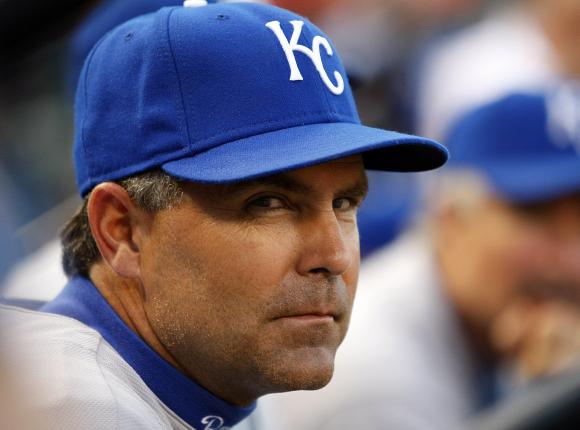
I think Trey Hillman is ready to be done. I can feel it.
The manager of the Royals looks tired. He looks confused. When his decisions are questioned, he seems to get defensive, and there's a look about him that gives you the feeling he may not really want to manage this team anymore.
Royals fans have seen this before.
The Royals just completed their longest road trip of the season, after a 6-4 loss to the Texas Rangers on Sunday. They went 3-8 on the trip, including getting swept in a four game series by Texas, and have currently lost five straight. They now find themselves, somehow, ten games under .500 at 11-21, last in the A.L. Central and 11.5 games back of the first place Minnesota Twins.
Yep. Sounds familiar.
Obviously, it's not all Hillman's fault. Not even close. The numerous bad free-agent signings made by GM Dayton Moore in the last couple of off-seasons have been well documented. The failure to develop sure-thing prospects certainly can't be blamed on the manager, either. The talent on the current major league roster is average at best.
Nevertheless, the Royals aren't average. They're not even bad. Ten games under .500 after five weeks of the season is horrendous.
Yet they're still third in the A.L. in hitting. The bullpen has somewhat seemed to settle down. Their starters are giving them a chance to win at, the very least, an average rate. So what gives?
Inevitably, yet fairly, we must look to the manager.
. . .
I found Saturday night's game versus Texas an especially frustrating one to watch.
Let's jump to the top of the seventh inning. It's a tie game. The Royals have a runner at third, two outs, and first baseman Kila Ka'aihue, getting his first start of the season, is due up. There's a lefty on the mound, and Kila is a left-handed hitter. Hillman had given Jose Guillen the night off, so he's available to pinch hit. Hillman does use Guillen as a pinch hitter, and he fails to drive the run in.
Now, if you're down by one or two runs in that situation, it seems pretty obvious to me that you send Guillen up to hit. He's your best power hitter and can tie the game or take the lead with one swing.
In a tie game though, there are many cons to that decision. Firstly, if you need a pinch hit later in the game, possibly in extra innings as the game looked to be destined for, you no longer have Guillen available. Secondly, unless you want to take Guillen's bat out of the lineup for the rest of the game, you have to put him in the field somewhere, and I can't figure anyone liking the idea of that.
Hillman chose to leave Guillen in the game and put him in right field, moving David DeJesus to left field, and moving Scott Podsednik from left field to center field. That forced Mitch Maier (who had made two spectacular plays in the game at center field already) to move to first base.
Maier, an above-average center fielder, had never played first base in a major league game before Saturday. DeJesus hadn't played left field since last season. And, of course, Guillen has proven to be worthy of the designated hitter role eternally.
Now, all the sudden, the Royals had four players (including Podsednik) who are either below average at their position or haven't played the position they're at this season - and of course, in Maier's case, any season.
The alternative to all this defensive shuffling would have been to simply use Willie Bloomquist in place of Guillen after his pinch hit at-bat, and put him at first base where Ka'aihue was playing. You then have generally your best defensive lineup in for the game's final few innings. More on that in a moment.
. . .
It's the bottom of the eighth now, and Gil Meche is easily having his best pitching performance of the season. He's already over 100 pitches, though. Given his injury history, it's a mere certainty Hillman will go to the bullpen now. Also, Meche has struggled all season, and it's important for him to leave the game on a good note.
Oddly, Hillman chooses to stay with Meche for the eighth. The first batter walks. It's the sixth free pass he's given out on the night. The camera moves to Hillman, who looks ready to walk out of the dugout and pull Meche. Usually, when managers stretch their starters this long, it only takes a baserunner to get the hook.
Instead, Hillman stays with Meche. The baserunner is caught stealing, so the decision seems to be vindicated, at least for the moment. The next batter walks. It's Meche's seventh of the game. The camera goes to Hillman, who again remains in the dugout. Two arms are ready in the bullpen if the manager needs them. Not yet, though.
The next hitter reaches on an infield single. Now there's two on and one out. The game is tied, and hot hitting Vladimir Guerrero is coming to the plate. This time Hillman comes out to talk to Meche, whose pitch count now is roughly 120. Hillman decides to stay with Meche.
Meche gets Guerrero on a fly out. There's two out now, and it's starting to look like the Royals may just get out of this jam. Meche needs one more.
 Now remember all that defensive shuffling a minute ago? This is when the decision to leave Guillen in the game (or use him as a pinch hitter at all) will come back to haunt Hillman. The next hitter, former Mizzou star Ian Kinsler, hits a line-drive to right. The ball looks catchable. The ball is catchable. Guillen runs in toward it. It looks like he can get to it. He doesn't. The ball drops, and by the replay, it looks as if it almost hit Guillen on the top of his cleats.
Royals fans collectively groan. It's probably a safe assumption that DeJesus would have gotten to the ball, but you never know. Either way, the go-ahead and eventual game-winning run scores. Another winnable game ends in a losing effort.
. . .
This is the life of the manager of the Kansas City Royals. When at a disadvantage talent-wise, the game management is under an even bigger microscope. Questionable decisions will often backfire. Worst-case scenarios become reality. The losses begin to weigh on the city and the team. Most of all, though, the losses take their toll on the manager, and there's only the next decision, next game, or next season for a chance at redemption.
It's likely the opportunity for Hillman has come and gone, and I get the sense he's okay with that.
*Thanks to firedayton.blogspot.com and Tony Gutierrez of kansascity.com for the images.
The manager of the Royals looks tired. He looks confused. When his decisions are questioned, he seems to get defensive, and there's a look about him that gives you the feeling he may not really want to manage this team anymore.
Royals fans have seen this before.
The Royals just completed their longest road trip of the season, after a 6-4 loss to the Texas Rangers on Sunday. They went 3-8 on the trip, including getting swept in a four game series by Texas, and have currently lost five straight. They now find themselves, somehow, ten games under .500 at 11-21, last in the A.L. Central and 11.5 games back of the first place Minnesota Twins.
Yep. Sounds familiar.
Obviously, it's not all Hillman's fault. Not even close. The numerous bad free-agent signings made by GM Dayton Moore in the last couple of off-seasons have been well documented. The failure to develop sure-thing prospects certainly can't be blamed on the manager, either. The talent on the current major league roster is average at best.
Nevertheless, the Royals aren't average. They're not even bad. Ten games under .500 after five weeks of the season is horrendous.
Yet they're still third in the A.L. in hitting. The bullpen has somewhat seemed to settle down. Their starters are giving them a chance to win at, the very least, an average rate. So what gives?
Inevitably, yet fairly, we must look to the manager.
. . .
I found Saturday night's game versus Texas an especially frustrating one to watch.
Let's jump to the top of the seventh inning. It's a tie game. The Royals have a runner at third, two outs, and first baseman Kila Ka'aihue, getting his first start of the season, is due up. There's a lefty on the mound, and Kila is a left-handed hitter. Hillman had given Jose Guillen the night off, so he's available to pinch hit. Hillman does use Guillen as a pinch hitter, and he fails to drive the run in.
Now, if you're down by one or two runs in that situation, it seems pretty obvious to me that you send Guillen up to hit. He's your best power hitter and can tie the game or take the lead with one swing.
In a tie game though, there are many cons to that decision. Firstly, if you need a pinch hit later in the game, possibly in extra innings as the game looked to be destined for, you no longer have Guillen available. Secondly, unless you want to take Guillen's bat out of the lineup for the rest of the game, you have to put him in the field somewhere, and I can't figure anyone liking the idea of that.
Hillman chose to leave Guillen in the game and put him in right field, moving David DeJesus to left field, and moving Scott Podsednik from left field to center field. That forced Mitch Maier (who had made two spectacular plays in the game at center field already) to move to first base.
Maier, an above-average center fielder, had never played first base in a major league game before Saturday. DeJesus hadn't played left field since last season. And, of course, Guillen has proven to be worthy of the designated hitter role eternally.
Now, all the sudden, the Royals had four players (including Podsednik) who are either below average at their position or haven't played the position they're at this season - and of course, in Maier's case, any season.
The alternative to all this defensive shuffling would have been to simply use Willie Bloomquist in place of Guillen after his pinch hit at-bat, and put him at first base where Ka'aihue was playing. You then have generally your best defensive lineup in for the game's final few innings. More on that in a moment.
. . .
It's the bottom of the eighth now, and Gil Meche is easily having his best pitching performance of the season. He's already over 100 pitches, though. Given his injury history, it's a mere certainty Hillman will go to the bullpen now. Also, Meche has struggled all season, and it's important for him to leave the game on a good note.
Oddly, Hillman chooses to stay with Meche for the eighth. The first batter walks. It's the sixth free pass he's given out on the night. The camera moves to Hillman, who looks ready to walk out of the dugout and pull Meche. Usually, when managers stretch their starters this long, it only takes a baserunner to get the hook.
Instead, Hillman stays with Meche. The baserunner is caught stealing, so the decision seems to be vindicated, at least for the moment. The next batter walks. It's Meche's seventh of the game. The camera goes to Hillman, who again remains in the dugout. Two arms are ready in the bullpen if the manager needs them. Not yet, though.
The next hitter reaches on an infield single. Now there's two on and one out. The game is tied, and hot hitting Vladimir Guerrero is coming to the plate. This time Hillman comes out to talk to Meche, whose pitch count now is roughly 120. Hillman decides to stay with Meche.
Meche gets Guerrero on a fly out. There's two out now, and it's starting to look like the Royals may just get out of this jam. Meche needs one more.
 Now remember all that defensive shuffling a minute ago? This is when the decision to leave Guillen in the game (or use him as a pinch hitter at all) will come back to haunt Hillman. The next hitter, former Mizzou star Ian Kinsler, hits a line-drive to right. The ball looks catchable. The ball is catchable. Guillen runs in toward it. It looks like he can get to it. He doesn't. The ball drops, and by the replay, it looks as if it almost hit Guillen on the top of his cleats.
Royals fans collectively groan. It's probably a safe assumption that DeJesus would have gotten to the ball, but you never know. Either way, the go-ahead and eventual game-winning run scores. Another winnable game ends in a losing effort.
. . .
This is the life of the manager of the Kansas City Royals. When at a disadvantage talent-wise, the game management is under an even bigger microscope. Questionable decisions will often backfire. Worst-case scenarios become reality. The losses begin to weigh on the city and the team. Most of all, though, the losses take their toll on the manager, and there's only the next decision, next game, or next season for a chance at redemption.
It's likely the opportunity for Hillman has come and gone, and I get the sense he's okay with that.
*Thanks to firedayton.blogspot.com and Tony Gutierrez of kansascity.com for the images.
Sunday, May 2, 2010
Conventional Wisdom Could Be the Problem
There's an interesting section of The Kansas City Star's website that has kind of gone under my radar for the first month of the season. It's called 'Judging the Royals', and it's based on a somewhat unorthodox system used to judge the Royals, mostly individually, over the course of the season.
The system is based off the 'Most Valuable Player' chart created some three decades ago by Coach Ron Polk, a member of the College Baseball Hall of Fame and the winningest coach in SEC history. After tweaking the system a bit with the help of Polk, Star contributor Lee Judge launched the updated system and site before the start of the current Royals season.
You can check it out for yourself, but basically, as Polk explains, "the system is designed to reward good baseball, hustle, and effort while punishing giving away free bases through walks and errors."
It seems pretty obvious, to me at least, that most coaches in baseball would already be preaching this type of attitude and philosophy on a daily basis, anyway. But not so fast.
The system's biggest influence, for pitchers anyway, is to throw strikes. The system does not punish hits. It punishes walks, especially lead-off walks to start an inning, worse than, say, a pitcher who gives up four runs or more in an appearance. Polk's opinion is that he can live with whatever happens when a pitcher throws strikes. He knows that with that, his pitchers will give up hits, and he can live with that.
"He's focused on effort and approach, not results, because he knows if the effort is correct, over time, the results will be there," Judge says.
The system also recognizes things that would go unnoticed in a box score. It rewards a catcher for not allowing a runner to advance by blocking a pitch in the dirt. There are also point categories for making a tough play look easy and mental mistakes - Billy Butler are you listening - that may have caused another teammate to commit an error.
I guess my point is that it's a shame that this isn't considered conventional wisdom in baseball, or at least with the Royals. It's a shame any of us could get this impressed by a system that seems so simple and obvious. Having watched the Royals lose the way they have (because of the bullpen) for the first month of this season, and really, for the last two decades, you just have to wonder what's really going on with this team.
How many lead-off walks does it take? How many failed sacrifices or unproductive outs or missed cut-off men does it take? Is it not time to buy into unconventional wisdom, or should we wait for another ten years of losing before considering alternatives?
Manager Trey Hillman cannot afford to wait. This is the last year of Hillman's contract and it's decision time for General Manager Dayton Moore. If Moore decides to offer Hillman a contract extension, it could ultimately end up costing both of them their jobs. If Moore decides to fire Hillman, then, well, Coach Polk, are you available?
Anyway, on to the game..
The Royals found a way to waste ANOTHER great start by pitcher Zack Greinke today, losing 1-0 to the Tampa Bay Rays. It's really come to the point where I would seriously not be surprised if we woke up tomorrow to hear that Greinke has quit baseball again.
I only had one beef with the way Hillman managed this one. First though, it's worth noting that he didn't have much to work with as the Royals only managed three hits off Rays rookie starting pitcher Wade Davis.*
*Why does it seem like the Royals always make rookie starting pitchers look like Cy Young Award winners? Since I can remember, it has always been a sign of bad things to come when I hear the Royals are facing a rookie, or even just facing a guy for the first time. On the other hand, it never seems to bode well for the Royals when they run out an unprepared rookie pitcher for the first time. Hmm.
Still, in the second inning, with two on, and nobody out, Hillman chose to bunt with Jason Kendall to advance the runners. Kendall popped the bunt up for an out, though, and the runners stayed put. The Royals, obviously given the final score, didn't score in the inning.
You may remember my blog about playing for the big inning versus small ball. The general point there was that, over the course of a season, trying to sacrifice runners ends up costing a team runs (and wins) over the long haul because the chances of getting a big inning are lowered after handing the opponent an out.
Now, let's fast forward to the seventh inning. At this point, the Rays are up 1-0, but the Royals have a runner at second with nobody out, and Mitch Maier is at the plate. My overall opinion about playing small ball is that, if you're going to use it, it should only be used in the seventh inning or later, in a one-run or tie game.
Let's not worry about my opinion, though. Regardless of what I think, Hillman has already played small ball once in the game, and most managers would tell you that if you're ever going to use it, now is the time. Mitch Maier has good bat control and the Royals desperately need a run. This is when you forgo the big inning to make sure and tie the game.
Hillman, instead, opted this time to let the hitter swing away. As we know, it did not end well, as the next three Royal hitters failed to come through. The Royals lost the game. Zack Greinke lost the game, and is now 0-3 with a 2.27 ERA. What's worse is the Royals are now 1-5 in his starts.* Ugh.
*I could go on about the Royals absolute WASTE of the best pitcher in baseball, but that has already been well documented by Joe Posnanski in the Star and on his blog. You really have to check it out, it's stunning.
Back to the point. The Royals offense today, while struggling, still had an opportunity to get a run or two if they could have just made the most of their opportunities. Managers in baseball absolutely love putting their stamp on the game, though some would argue that baseball is the sport where coaching has the least to do with the outcome. Actually, that's probably why most baseball managers jump at the chance to make an impact in the game.
Anyway, today, when presented with the opportunity on two different occasions, Hillman made the wrong decision in both instances. I'm not saying the Royals lost because of Hillman. The Royals lost for many reasons, and when you get three hits and lose 1-0, it's hard to blame the loss on the manager. But with the talent disadvantage the Royals seem to be at, it will be absolutely impossible for them to win with Hillman's odd and inconsistent decision-making, like we saw today.
The system is based off the 'Most Valuable Player' chart created some three decades ago by Coach Ron Polk, a member of the College Baseball Hall of Fame and the winningest coach in SEC history. After tweaking the system a bit with the help of Polk, Star contributor Lee Judge launched the updated system and site before the start of the current Royals season.
You can check it out for yourself, but basically, as Polk explains, "the system is designed to reward good baseball, hustle, and effort while punishing giving away free bases through walks and errors."
It seems pretty obvious, to me at least, that most coaches in baseball would already be preaching this type of attitude and philosophy on a daily basis, anyway. But not so fast.
The system's biggest influence, for pitchers anyway, is to throw strikes. The system does not punish hits. It punishes walks, especially lead-off walks to start an inning, worse than, say, a pitcher who gives up four runs or more in an appearance. Polk's opinion is that he can live with whatever happens when a pitcher throws strikes. He knows that with that, his pitchers will give up hits, and he can live with that.
"He's focused on effort and approach, not results, because he knows if the effort is correct, over time, the results will be there," Judge says.
The system also recognizes things that would go unnoticed in a box score. It rewards a catcher for not allowing a runner to advance by blocking a pitch in the dirt. There are also point categories for making a tough play look easy and mental mistakes - Billy Butler are you listening - that may have caused another teammate to commit an error.
I guess my point is that it's a shame that this isn't considered conventional wisdom in baseball, or at least with the Royals. It's a shame any of us could get this impressed by a system that seems so simple and obvious. Having watched the Royals lose the way they have (because of the bullpen) for the first month of this season, and really, for the last two decades, you just have to wonder what's really going on with this team.
How many lead-off walks does it take? How many failed sacrifices or unproductive outs or missed cut-off men does it take? Is it not time to buy into unconventional wisdom, or should we wait for another ten years of losing before considering alternatives?
Manager Trey Hillman cannot afford to wait. This is the last year of Hillman's contract and it's decision time for General Manager Dayton Moore. If Moore decides to offer Hillman a contract extension, it could ultimately end up costing both of them their jobs. If Moore decides to fire Hillman, then, well, Coach Polk, are you available?
Anyway, on to the game..
The Royals found a way to waste ANOTHER great start by pitcher Zack Greinke today, losing 1-0 to the Tampa Bay Rays. It's really come to the point where I would seriously not be surprised if we woke up tomorrow to hear that Greinke has quit baseball again.
I only had one beef with the way Hillman managed this one. First though, it's worth noting that he didn't have much to work with as the Royals only managed three hits off Rays rookie starting pitcher Wade Davis.*
*Why does it seem like the Royals always make rookie starting pitchers look like Cy Young Award winners? Since I can remember, it has always been a sign of bad things to come when I hear the Royals are facing a rookie, or even just facing a guy for the first time. On the other hand, it never seems to bode well for the Royals when they run out an unprepared rookie pitcher for the first time. Hmm.
Still, in the second inning, with two on, and nobody out, Hillman chose to bunt with Jason Kendall to advance the runners. Kendall popped the bunt up for an out, though, and the runners stayed put. The Royals, obviously given the final score, didn't score in the inning.
You may remember my blog about playing for the big inning versus small ball. The general point there was that, over the course of a season, trying to sacrifice runners ends up costing a team runs (and wins) over the long haul because the chances of getting a big inning are lowered after handing the opponent an out.
Now, let's fast forward to the seventh inning. At this point, the Rays are up 1-0, but the Royals have a runner at second with nobody out, and Mitch Maier is at the plate. My overall opinion about playing small ball is that, if you're going to use it, it should only be used in the seventh inning or later, in a one-run or tie game.
Let's not worry about my opinion, though. Regardless of what I think, Hillman has already played small ball once in the game, and most managers would tell you that if you're ever going to use it, now is the time. Mitch Maier has good bat control and the Royals desperately need a run. This is when you forgo the big inning to make sure and tie the game.
Hillman, instead, opted this time to let the hitter swing away. As we know, it did not end well, as the next three Royal hitters failed to come through. The Royals lost the game. Zack Greinke lost the game, and is now 0-3 with a 2.27 ERA. What's worse is the Royals are now 1-5 in his starts.* Ugh.
*I could go on about the Royals absolute WASTE of the best pitcher in baseball, but that has already been well documented by Joe Posnanski in the Star and on his blog. You really have to check it out, it's stunning.
Back to the point. The Royals offense today, while struggling, still had an opportunity to get a run or two if they could have just made the most of their opportunities. Managers in baseball absolutely love putting their stamp on the game, though some would argue that baseball is the sport where coaching has the least to do with the outcome. Actually, that's probably why most baseball managers jump at the chance to make an impact in the game.
Anyway, today, when presented with the opportunity on two different occasions, Hillman made the wrong decision in both instances. I'm not saying the Royals lost because of Hillman. The Royals lost for many reasons, and when you get three hits and lose 1-0, it's hard to blame the loss on the manager. But with the talent disadvantage the Royals seem to be at, it will be absolutely impossible for them to win with Hillman's odd and inconsistent decision-making, like we saw today.
Monday, April 19, 2010
The Big Inning
On my way to work yesterday morning I got a chance to listen to my favorite sports talk radio announcer, Soren Petro. For reasons I cannot control, I haven't gotten a chance to listen to sports radio 810 in awhile, let alone Soren.
Soren is my favorite radio personality (on all formats) for many reasons, but none more than his no b.s. tone when it comes to the inadequacy of the Chiefs and Royals. Maybe it was his time away from Kansas City at Syracuse University that helped shape his view of what we, as fans, can and should expect out of our local teams. In any event, I guess I just feel like my level of frustration with the professional teams in Kansas City is echoed during his show.
Anyway, in the first segment of his program, which happens to be called "The Program", he discussed the Royals 10-5 victory over the Twins on Sunday. The game was more or less decided by the six spot the Royals' offense posted in the third inning. I caught only a couple minutes of the segment, but the general point of Soren's spiel was that the team that scores the most runs in any one single inning, or more generally the team that has the biggest inning, will usually win the game.
Soren cited that after Sunday's win, in all Royals games, the team that had the biggest inning was 10-1-1 in those 12 games (the tie being when neither team had a bigger inning than the other). Pushing further, he raised the possibility that teams like the Royals, who often play "small ball" and sacrifice and move runners to maximize their chances of scoring at least one run in an inning, are actually hurting, not helping, their chances of winning.
So after the Royals' forgettable 8-1 loss in Toronto Monday night, I decided to research it a bit. After checking on Soren's tally and adding in Monday's game, the team that has the biggest inning is now 11-1-1 in all Royals games.
I wanted a bigger sample, though. Reviewing all Major League games through Monday, the team that has the biggest inning is 132-19-46. That's an .874 winning percentage.
I wanted to see if the trend changed from good teams to bad teams, so I researched what the records were for the teams with the best and worst records in baseball. That would be the Rays (best) and Orioles (worst). But because those two teams have played eachother six times already this season, therefore making the comparison between the two fairly obsolete, I ditched the Rays for the Phillies, who are probably the best team in baseball, anyway.
For Philadelphia's games, the big inning team was 8-2-2, and for Baltimore it was a glaring 10-0-4. So the trend continues.
Managers like the Royals' Trey Hillman will often cite the team's lack of power (lack of talent) as to why they play small ball. More or less, they're saying, "We don't hit well enough to count on the big inning, so we ought to make sure and at least score one when we can."
Soren, naturally, has a different take. He actually looks at it the opposite as Hillman or any other small ball defender does. He believes that teams like the Royals, who openly admit they're at a talent disadvantage basically every night, can even less afford to ignore a glaring trend like this, because, as previously stated, they don't have the talent to make up for it. In other words, teams like the Phillies and Yankees can win in spite of the numbers (or in spite of not "playing the numbers") more often than a team like the Royals because they're more talented.
I don't know if any of this means anything. I, as much as any other baseball junkie, have this thing with numbers. You see, it doesn't matter what the numbers are, or really, how relevant they are. You just have to have numbers, and we're happy.
I do know I'll be thinking about this the next time the Royals play for one run in an inning. Especially in a game that ends up being decided by two or three runs. "What if they didn't bunt him over? That guy might have singled, and the extra guy up in the inning would have hit the three-run home run we needed!" And so on.
I also know that with the way the Royals' bullpen has pitched, they'll be the ones GIVING UP the big inning more often than not. Actually, that's already true so far, given the Royals' record is 5-8 through Monday. Okay, so maybe the talk should be more about minizing the big inning while pitching.
And so there you have it. Another trend directly correlating to victories that can be traced back to the bullpen's struggles. Many a Royals manager have tried and failed at solving that riddle. My guess is, possibly to no fault of his own, Hillman won't find the answer, either.
Soren is my favorite radio personality (on all formats) for many reasons, but none more than his no b.s. tone when it comes to the inadequacy of the Chiefs and Royals. Maybe it was his time away from Kansas City at Syracuse University that helped shape his view of what we, as fans, can and should expect out of our local teams. In any event, I guess I just feel like my level of frustration with the professional teams in Kansas City is echoed during his show.
Anyway, in the first segment of his program, which happens to be called "The Program", he discussed the Royals 10-5 victory over the Twins on Sunday. The game was more or less decided by the six spot the Royals' offense posted in the third inning. I caught only a couple minutes of the segment, but the general point of Soren's spiel was that the team that scores the most runs in any one single inning, or more generally the team that has the biggest inning, will usually win the game.
Soren cited that after Sunday's win, in all Royals games, the team that had the biggest inning was 10-1-1 in those 12 games (the tie being when neither team had a bigger inning than the other). Pushing further, he raised the possibility that teams like the Royals, who often play "small ball" and sacrifice and move runners to maximize their chances of scoring at least one run in an inning, are actually hurting, not helping, their chances of winning.
So after the Royals' forgettable 8-1 loss in Toronto Monday night, I decided to research it a bit. After checking on Soren's tally and adding in Monday's game, the team that has the biggest inning is now 11-1-1 in all Royals games.
I wanted a bigger sample, though. Reviewing all Major League games through Monday, the team that has the biggest inning is 132-19-46. That's an .874 winning percentage.
I wanted to see if the trend changed from good teams to bad teams, so I researched what the records were for the teams with the best and worst records in baseball. That would be the Rays (best) and Orioles (worst). But because those two teams have played eachother six times already this season, therefore making the comparison between the two fairly obsolete, I ditched the Rays for the Phillies, who are probably the best team in baseball, anyway.
For Philadelphia's games, the big inning team was 8-2-2, and for Baltimore it was a glaring 10-0-4. So the trend continues.
Managers like the Royals' Trey Hillman will often cite the team's lack of power (lack of talent) as to why they play small ball. More or less, they're saying, "We don't hit well enough to count on the big inning, so we ought to make sure and at least score one when we can."
Soren, naturally, has a different take. He actually looks at it the opposite as Hillman or any other small ball defender does. He believes that teams like the Royals, who openly admit they're at a talent disadvantage basically every night, can even less afford to ignore a glaring trend like this, because, as previously stated, they don't have the talent to make up for it. In other words, teams like the Phillies and Yankees can win in spite of the numbers (or in spite of not "playing the numbers") more often than a team like the Royals because they're more talented.
I don't know if any of this means anything. I, as much as any other baseball junkie, have this thing with numbers. You see, it doesn't matter what the numbers are, or really, how relevant they are. You just have to have numbers, and we're happy.
I do know I'll be thinking about this the next time the Royals play for one run in an inning. Especially in a game that ends up being decided by two or three runs. "What if they didn't bunt him over? That guy might have singled, and the extra guy up in the inning would have hit the three-run home run we needed!" And so on.
I also know that with the way the Royals' bullpen has pitched, they'll be the ones GIVING UP the big inning more often than not. Actually, that's already true so far, given the Royals' record is 5-8 through Monday. Okay, so maybe the talk should be more about minizing the big inning while pitching.
And so there you have it. Another trend directly correlating to victories that can be traced back to the bullpen's struggles. Many a Royals manager have tried and failed at solving that riddle. My guess is, possibly to no fault of his own, Hillman won't find the answer, either.
Monday, April 12, 2010
Royals Haven't Learned Anything
After a full week of baseball, I wanted to throw around some thoughts I have about the 2010 version of the Royals, and what got us here.
The first is obvious. This team is bad. They're not horribly bad. This Royals squad shouldn't approach '62 Mets status, though it might make for better entertainment value if they did lose more.
I think that might be part of the problem. There's enough decent veteran presence on this team to the point where the games aren't laughable on most nights, but at the same time, they're still losing most of the time. They aren't particularly good or bad at any one thing (although blown saves by the bullpen is becoming quite the trend). They just seem to be a below average team that has absolutely no star power on the nights Zack Greinke isn't pitching.
And I'm not jumping to any conclusions on Greinke, but let's face it, expecting Zack to follow-up his Cy Young performance last season with the same results this season is unreasonable and unfair. So if Zack comes back down to earth this year, why would anyone want to watch this team?
It's who we're watching that makes it so frustrating. When Dayton Moore was first hired as general manager of the Royals, he made it clear the goal year for the tide to turn in Kansas City was 2010. Well, as weird as it sounds, it is 2010, and the Royals major league roster is no more talented than it was ten years ago when Allard Baird was calling the shots.
The Royals have spent records amount of money on scouting and in the draft, yet half of their starting lineup on opening day were retreads who couldn't catch on with any other team. They're stop-gaps*. Rick Ankiel signed with Kansas City this offseason strictly because the Royals were the only team to guarantee him a starting position. That means, in theory, that every other major league team decided that their current center fielder was as good as or better than Rick Ankiel. More so, in theory, it means the Royals starting center fielder is considered the worst (or more fairly, one of the worst) starting center fielders in all of baseball, according to the scouts and GMs on the 29 other teams. After putting that altogether, it seems almost unbelievable that the aforementioned player was the Royals' biggest improvement in the offseason following a 97-loss season.
*Of the nine hitters in the batting order on opening day, five of them (Scott Podsednik, Ankiel, Jose Guillen, Willie Bloomquist, and Jason Kendall) are stop-gaps, or guys who will not be here the day, if it ever comes, that the Royals start winning. Where are the prospects? Are we drafting the wrong guys or is the problem in development? I'm reminded of the 2003 Detroit Tigers team. That team lost the most games ever in the American League, but they did it with a very young pitching staff and a few young hitters who would eventually develop into a talented enough group to help the Tigers win the A.L. pennant in 2006. This Royals team is losing mostly with guys who won't be here in two years. There'll be no return on any fan investment this year, next year, and judging by the last two decades, not ten years from now. It's like they're losing for nothing.
I don't want it to sound like I'm picking on Ankiel. Actually, in the small sample we've gotten so far, he seems like a guy who hustles and plays the game hard. His bat certainly has some pop, as he showed in a four-hit performance on Friday in the Royals' only winning effort over the weekend.
He is, though, a microcosm of what's gone wrong with the Royals and why they still aren't winning. After a tough, injury plagued season last year, the Royals gave Ankiel a contract based on the hope that he'd return to form and hit 20 or so home runs. Now, maybe it will pay off. More likely, though, it won't.
The Gil Meche signing before the 2007 season is a prime example. The Royals gave Meche the biggest contract in team history - $55 million over five years - on the hope that he would take the step from average pitcher to good pitcher. It's the equivalent to you going to work Monday morning, and your boss greets you by letting you know you'll be getting a sizeable raise because, though your work hasn't improved recently, he/she has a hunch you're about to turn the corner. And then, of course, three years later, you not only missed the turn, but you took a u-turn and are a worse employee than you were to start with. Of course, you're still getting paid.
This all trails back to Dayton Moore. I was a fan of owner David Glass hiring Moore at the time, and I haven't completely given up on him yet. Something's got to give, though.
The Royals' brass decided the bullpen would improve by default this year after repeated bad performances last season. And that came after a 2008 season that saw the bullpen emerge as a strong point for the Royals. The start of the downturn came in the offseason before the 2009 season when Moore made two very pivotal mistakes. The biggest of the two was when he traded away the young and cheap hard throwing reliever Leo Nunez to the Marlins for overpaid, low on-base percentage strikeout king, Mike Jacobs. The other mistake was trading another young reliever, Ramon Ramirez, to the Red Sox for center fielder Coco Crisp. The Crisp deal made much more sense, adding speed and defense to the team, but an injury took him out of the lineup for good by May, and the Royals never saw a return on him. Both players are now playing for other teams, which tells us both moves were definitely bad decisions in hindsight.
What made it worse was how Moore replaced Nunez and Ramirez. Enter Kyle Farnsworth and Juan Cruz. Some $10 million later, the Royals haven't improved their offense, have less talent in the bullpen, and less money to shop for free agents in the coming years to try and right their wrongs.
It seems simple, I know, yet we're really just scratching the surface here. These kind of mistakes are what got the Royals here. If a remedy isn't found soon, we'll surely be in for another decade of the same.
The first is obvious. This team is bad. They're not horribly bad. This Royals squad shouldn't approach '62 Mets status, though it might make for better entertainment value if they did lose more.
I think that might be part of the problem. There's enough decent veteran presence on this team to the point where the games aren't laughable on most nights, but at the same time, they're still losing most of the time. They aren't particularly good or bad at any one thing (although blown saves by the bullpen is becoming quite the trend). They just seem to be a below average team that has absolutely no star power on the nights Zack Greinke isn't pitching.
And I'm not jumping to any conclusions on Greinke, but let's face it, expecting Zack to follow-up his Cy Young performance last season with the same results this season is unreasonable and unfair. So if Zack comes back down to earth this year, why would anyone want to watch this team?
It's who we're watching that makes it so frustrating. When Dayton Moore was first hired as general manager of the Royals, he made it clear the goal year for the tide to turn in Kansas City was 2010. Well, as weird as it sounds, it is 2010, and the Royals major league roster is no more talented than it was ten years ago when Allard Baird was calling the shots.
The Royals have spent records amount of money on scouting and in the draft, yet half of their starting lineup on opening day were retreads who couldn't catch on with any other team. They're stop-gaps*. Rick Ankiel signed with Kansas City this offseason strictly because the Royals were the only team to guarantee him a starting position. That means, in theory, that every other major league team decided that their current center fielder was as good as or better than Rick Ankiel. More so, in theory, it means the Royals starting center fielder is considered the worst (or more fairly, one of the worst) starting center fielders in all of baseball, according to the scouts and GMs on the 29 other teams. After putting that altogether, it seems almost unbelievable that the aforementioned player was the Royals' biggest improvement in the offseason following a 97-loss season.
*Of the nine hitters in the batting order on opening day, five of them (Scott Podsednik, Ankiel, Jose Guillen, Willie Bloomquist, and Jason Kendall) are stop-gaps, or guys who will not be here the day, if it ever comes, that the Royals start winning. Where are the prospects? Are we drafting the wrong guys or is the problem in development? I'm reminded of the 2003 Detroit Tigers team. That team lost the most games ever in the American League, but they did it with a very young pitching staff and a few young hitters who would eventually develop into a talented enough group to help the Tigers win the A.L. pennant in 2006. This Royals team is losing mostly with guys who won't be here in two years. There'll be no return on any fan investment this year, next year, and judging by the last two decades, not ten years from now. It's like they're losing for nothing.
I don't want it to sound like I'm picking on Ankiel. Actually, in the small sample we've gotten so far, he seems like a guy who hustles and plays the game hard. His bat certainly has some pop, as he showed in a four-hit performance on Friday in the Royals' only winning effort over the weekend.
He is, though, a microcosm of what's gone wrong with the Royals and why they still aren't winning. After a tough, injury plagued season last year, the Royals gave Ankiel a contract based on the hope that he'd return to form and hit 20 or so home runs. Now, maybe it will pay off. More likely, though, it won't.
The Gil Meche signing before the 2007 season is a prime example. The Royals gave Meche the biggest contract in team history - $55 million over five years - on the hope that he would take the step from average pitcher to good pitcher. It's the equivalent to you going to work Monday morning, and your boss greets you by letting you know you'll be getting a sizeable raise because, though your work hasn't improved recently, he/she has a hunch you're about to turn the corner. And then, of course, three years later, you not only missed the turn, but you took a u-turn and are a worse employee than you were to start with. Of course, you're still getting paid.
This all trails back to Dayton Moore. I was a fan of owner David Glass hiring Moore at the time, and I haven't completely given up on him yet. Something's got to give, though.
The Royals' brass decided the bullpen would improve by default this year after repeated bad performances last season. And that came after a 2008 season that saw the bullpen emerge as a strong point for the Royals. The start of the downturn came in the offseason before the 2009 season when Moore made two very pivotal mistakes. The biggest of the two was when he traded away the young and cheap hard throwing reliever Leo Nunez to the Marlins for overpaid, low on-base percentage strikeout king, Mike Jacobs. The other mistake was trading another young reliever, Ramon Ramirez, to the Red Sox for center fielder Coco Crisp. The Crisp deal made much more sense, adding speed and defense to the team, but an injury took him out of the lineup for good by May, and the Royals never saw a return on him. Both players are now playing for other teams, which tells us both moves were definitely bad decisions in hindsight.
What made it worse was how Moore replaced Nunez and Ramirez. Enter Kyle Farnsworth and Juan Cruz. Some $10 million later, the Royals haven't improved their offense, have less talent in the bullpen, and less money to shop for free agents in the coming years to try and right their wrongs.
It seems simple, I know, yet we're really just scratching the surface here. These kind of mistakes are what got the Royals here. If a remedy isn't found soon, we'll surely be in for another decade of the same.
Subscribe to:
Posts (Atom)