Another August in Kansas City is approaching. In about a week, the Chiefs first training camp in St. Joseph, MO will be underway, and baseball in this town will more or less be forgotten.
It's already become a complete afterthought. With the unexplainable 2003 season being the exception, this is actually a little late in the year for the Royals to fade from relevancy. So we know this feeling pretty well.
Just before the All-Star break, the Royals had begun to toy with us a bit by winning 10 of 13 games. Many were questioning whether the organization, who because of all the losing is a usual seller in the trade market, would forego trading some of their biggest commodities for future prospects in hopes of contending this year.
Then, manager Ned Yost proclaimed the team was very much in the race and could be in first place in as little as a week. Apparently, being a mere eight games under .500 is right where you want your ball club to be for the stretch run.
Of course, if you were paying any attention - and you probably weren't - you know by now that the Royals were swept in consecutive series on each side of the break and most of the talk about a pennant race has turned to trade rumors. Hopefully Yost has got some sleep and some of his sense back since then as well.
Look, the trade talk has been the talk all along. Anyone thinking this team is or was a contender at any point during this season is just downright insane. Don't get me wrong, picking up a few victories here and there and avoiding last place will have its value (helping to build confidence in the young guys and possibly helping persuade next year's free agent targets that the team is turning the corner). But the value is minimal.
It was more or less a blessing in disguise for GM Dayton Moore when the Royals hit their six-game skid. At that point, there was no doubt he should focus on the future and could do so without getting heat from the fans and media for giving up on the current season.
So what should Moore do? The trade deadline is July 31st, just ten days away, and the Royals have done nothing thus far, though it seems something huge is about happen. What are some options?
The biggest commodity the Royals have is OF David DeJesus. Let it be known that this blogger believes that DeJesus is the only deserving All-Star on the team currently. Take nothing away from Joakim Soria (the Royals' lone representative) or Billy Butler or whoever, but DeJesus has been a complete player this season. He leads the team in hitting, his defense has been spectacular (he plays all three outfield positions), and his overall numbers compare quite well to that of Ichiro Suzuki, who was the starting RF and lead-off hitter for the American League this year.
It has been reported that the Royals are asking for, at the very least, a major league-ready prospect as part of the package in return for DeJesus. Experts say the asking price may be too high, but Moore has that luxury. The club has an option to retain DeJesus next season for $6 million (not bad if you consider they're paying Guillen $12 a year). If they choose to go that route, then at this point next year, if the team is in a similar position (if they're still losing), Moore can shop DeJesus just like he is now.
Also, if DeJesus does become a free agent and signs elsewhere, the Royals will receive compensatory draft picks - one 1st round and the other between the 1st and 2nd rounds - in return for him, somewhat like a trade.
So Moore shouldn't feel any pressure to trade DeJesus. Really, he should feel pressured to retain him, the guy has to be the most popular player on the team.* And it's not out of the question that DeJesus could be a part of a winning future for this club. It's all up to Moore and a few of his developing prospects.
*You know what I'm talking about guys. If you're ever at the ballpark, check out the difference in tone when the crowd cheers for DeJesus coming up to bat. Women just go crazy for the guy, I don't get it.
Moore has plenty more to think about than just DeJesus, though. Kyle Farnsworth is pitching better than he ever has and is a free agent after this season. Every contending team is looking for bullpen help, so it would seem a mere certainty that his days in a Royals uniform are numbered.
Third baseman Alberto Callaspo has been mentioned in trade rumors, and this goes all the way back to spring training. It makes perfect sense given that the organization's top overall prospect, Mike Moustakas, plays the same position, and should be playing there by opening day next season.
The man that seems destined to go, though, is Guillen. Really, the closer we get to the trade deadline, the more worrisome I become that Moore is not going to trade Guillen. There really would be no excuse for this. The Royals ride with Guillen has been bumpy at best, and there's virtually no chance they'll try and bring him back past this season.
The club has Kila Ka'aihue and Alex Gordon terrorizing overmatched competition at Triple-A Omaha. Kila is ready for his first real chance to be a major leaguer - and it's been long overdue - while Gordon has transitioned to left field well is ready for a second chance to prove his worthiness of a roster spot on the big league squad.
Most importantly, though, both are vital parts to a future in which Moore has been working to build for about five years now. All Guillen is doing is blocking a roster spot for one of those players. The Royals should be willling to take on all of his remaining salary if that's what it takes to trade him. He means more off this team than on it because he can contribute nothing towards the future. If Moore fails to trade Guillen, it would be a bigger misstep than his original decision to sign him three years ago.
The only bad news we could get these next couple of weeks would be if there is no news. Moore must act now. The Royals are in the position they're in now, because past GMs, when given real opportunities to improve for the future like the one Moore has now, either weren't aggressive enough or didn't do their homework. If Moore plays his cards right, the Royals could make real progress toward contending in the near future.
If he doesn't, we'll be right back here next year, talking Chiefs football in the middle of summer.
Showing posts with label David DeJesus. Show all posts
Showing posts with label David DeJesus. Show all posts
Wednesday, July 21, 2010

Sunday, May 9, 2010
Hillman May Be Ready to Move On
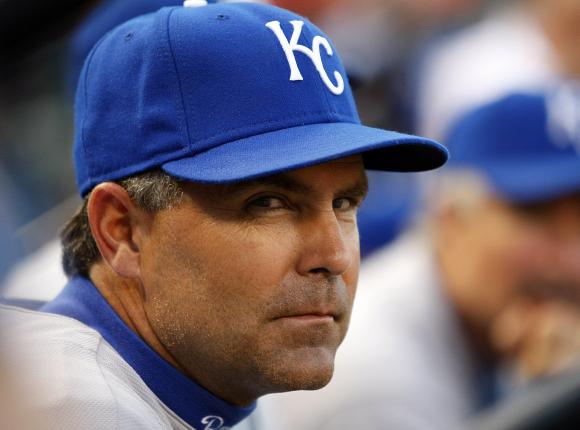
I think Trey Hillman is ready to be done. I can feel it.
The manager of the Royals looks tired. He looks confused. When his decisions are questioned, he seems to get defensive, and there's a look about him that gives you the feeling he may not really want to manage this team anymore.
Royals fans have seen this before.
The Royals just completed their longest road trip of the season, after a 6-4 loss to the Texas Rangers on Sunday. They went 3-8 on the trip, including getting swept in a four game series by Texas, and have currently lost five straight. They now find themselves, somehow, ten games under .500 at 11-21, last in the A.L. Central and 11.5 games back of the first place Minnesota Twins.
Yep. Sounds familiar.
Obviously, it's not all Hillman's fault. Not even close. The numerous bad free-agent signings made by GM Dayton Moore in the last couple of off-seasons have been well documented. The failure to develop sure-thing prospects certainly can't be blamed on the manager, either. The talent on the current major league roster is average at best.
Nevertheless, the Royals aren't average. They're not even bad. Ten games under .500 after five weeks of the season is horrendous.
Yet they're still third in the A.L. in hitting. The bullpen has somewhat seemed to settle down. Their starters are giving them a chance to win at, the very least, an average rate. So what gives?
Inevitably, yet fairly, we must look to the manager.
. . .
I found Saturday night's game versus Texas an especially frustrating one to watch.
Let's jump to the top of the seventh inning. It's a tie game. The Royals have a runner at third, two outs, and first baseman Kila Ka'aihue, getting his first start of the season, is due up. There's a lefty on the mound, and Kila is a left-handed hitter. Hillman had given Jose Guillen the night off, so he's available to pinch hit. Hillman does use Guillen as a pinch hitter, and he fails to drive the run in.
Now, if you're down by one or two runs in that situation, it seems pretty obvious to me that you send Guillen up to hit. He's your best power hitter and can tie the game or take the lead with one swing.
In a tie game though, there are many cons to that decision. Firstly, if you need a pinch hit later in the game, possibly in extra innings as the game looked to be destined for, you no longer have Guillen available. Secondly, unless you want to take Guillen's bat out of the lineup for the rest of the game, you have to put him in the field somewhere, and I can't figure anyone liking the idea of that.
Hillman chose to leave Guillen in the game and put him in right field, moving David DeJesus to left field, and moving Scott Podsednik from left field to center field. That forced Mitch Maier (who had made two spectacular plays in the game at center field already) to move to first base.
Maier, an above-average center fielder, had never played first base in a major league game before Saturday. DeJesus hadn't played left field since last season. And, of course, Guillen has proven to be worthy of the designated hitter role eternally.
Now, all the sudden, the Royals had four players (including Podsednik) who are either below average at their position or haven't played the position they're at this season - and of course, in Maier's case, any season.
The alternative to all this defensive shuffling would have been to simply use Willie Bloomquist in place of Guillen after his pinch hit at-bat, and put him at first base where Ka'aihue was playing. You then have generally your best defensive lineup in for the game's final few innings. More on that in a moment.
. . .
It's the bottom of the eighth now, and Gil Meche is easily having his best pitching performance of the season. He's already over 100 pitches, though. Given his injury history, it's a mere certainty Hillman will go to the bullpen now. Also, Meche has struggled all season, and it's important for him to leave the game on a good note.
Oddly, Hillman chooses to stay with Meche for the eighth. The first batter walks. It's the sixth free pass he's given out on the night. The camera moves to Hillman, who looks ready to walk out of the dugout and pull Meche. Usually, when managers stretch their starters this long, it only takes a baserunner to get the hook.
Instead, Hillman stays with Meche. The baserunner is caught stealing, so the decision seems to be vindicated, at least for the moment. The next batter walks. It's Meche's seventh of the game. The camera goes to Hillman, who again remains in the dugout. Two arms are ready in the bullpen if the manager needs them. Not yet, though.
The next hitter reaches on an infield single. Now there's two on and one out. The game is tied, and hot hitting Vladimir Guerrero is coming to the plate. This time Hillman comes out to talk to Meche, whose pitch count now is roughly 120. Hillman decides to stay with Meche.
Meche gets Guerrero on a fly out. There's two out now, and it's starting to look like the Royals may just get out of this jam. Meche needs one more.
 Now remember all that defensive shuffling a minute ago? This is when the decision to leave Guillen in the game (or use him as a pinch hitter at all) will come back to haunt Hillman. The next hitter, former Mizzou star Ian Kinsler, hits a line-drive to right. The ball looks catchable. The ball is catchable. Guillen runs in toward it. It looks like he can get to it. He doesn't. The ball drops, and by the replay, it looks as if it almost hit Guillen on the top of his cleats.
Royals fans collectively groan. It's probably a safe assumption that DeJesus would have gotten to the ball, but you never know. Either way, the go-ahead and eventual game-winning run scores. Another winnable game ends in a losing effort.
. . .
This is the life of the manager of the Kansas City Royals. When at a disadvantage talent-wise, the game management is under an even bigger microscope. Questionable decisions will often backfire. Worst-case scenarios become reality. The losses begin to weigh on the city and the team. Most of all, though, the losses take their toll on the manager, and there's only the next decision, next game, or next season for a chance at redemption.
It's likely the opportunity for Hillman has come and gone, and I get the sense he's okay with that.
*Thanks to firedayton.blogspot.com and Tony Gutierrez of kansascity.com for the images.
The manager of the Royals looks tired. He looks confused. When his decisions are questioned, he seems to get defensive, and there's a look about him that gives you the feeling he may not really want to manage this team anymore.
Royals fans have seen this before.
The Royals just completed their longest road trip of the season, after a 6-4 loss to the Texas Rangers on Sunday. They went 3-8 on the trip, including getting swept in a four game series by Texas, and have currently lost five straight. They now find themselves, somehow, ten games under .500 at 11-21, last in the A.L. Central and 11.5 games back of the first place Minnesota Twins.
Yep. Sounds familiar.
Obviously, it's not all Hillman's fault. Not even close. The numerous bad free-agent signings made by GM Dayton Moore in the last couple of off-seasons have been well documented. The failure to develop sure-thing prospects certainly can't be blamed on the manager, either. The talent on the current major league roster is average at best.
Nevertheless, the Royals aren't average. They're not even bad. Ten games under .500 after five weeks of the season is horrendous.
Yet they're still third in the A.L. in hitting. The bullpen has somewhat seemed to settle down. Their starters are giving them a chance to win at, the very least, an average rate. So what gives?
Inevitably, yet fairly, we must look to the manager.
. . .
I found Saturday night's game versus Texas an especially frustrating one to watch.
Let's jump to the top of the seventh inning. It's a tie game. The Royals have a runner at third, two outs, and first baseman Kila Ka'aihue, getting his first start of the season, is due up. There's a lefty on the mound, and Kila is a left-handed hitter. Hillman had given Jose Guillen the night off, so he's available to pinch hit. Hillman does use Guillen as a pinch hitter, and he fails to drive the run in.
Now, if you're down by one or two runs in that situation, it seems pretty obvious to me that you send Guillen up to hit. He's your best power hitter and can tie the game or take the lead with one swing.
In a tie game though, there are many cons to that decision. Firstly, if you need a pinch hit later in the game, possibly in extra innings as the game looked to be destined for, you no longer have Guillen available. Secondly, unless you want to take Guillen's bat out of the lineup for the rest of the game, you have to put him in the field somewhere, and I can't figure anyone liking the idea of that.
Hillman chose to leave Guillen in the game and put him in right field, moving David DeJesus to left field, and moving Scott Podsednik from left field to center field. That forced Mitch Maier (who had made two spectacular plays in the game at center field already) to move to first base.
Maier, an above-average center fielder, had never played first base in a major league game before Saturday. DeJesus hadn't played left field since last season. And, of course, Guillen has proven to be worthy of the designated hitter role eternally.
Now, all the sudden, the Royals had four players (including Podsednik) who are either below average at their position or haven't played the position they're at this season - and of course, in Maier's case, any season.
The alternative to all this defensive shuffling would have been to simply use Willie Bloomquist in place of Guillen after his pinch hit at-bat, and put him at first base where Ka'aihue was playing. You then have generally your best defensive lineup in for the game's final few innings. More on that in a moment.
. . .
It's the bottom of the eighth now, and Gil Meche is easily having his best pitching performance of the season. He's already over 100 pitches, though. Given his injury history, it's a mere certainty Hillman will go to the bullpen now. Also, Meche has struggled all season, and it's important for him to leave the game on a good note.
Oddly, Hillman chooses to stay with Meche for the eighth. The first batter walks. It's the sixth free pass he's given out on the night. The camera moves to Hillman, who looks ready to walk out of the dugout and pull Meche. Usually, when managers stretch their starters this long, it only takes a baserunner to get the hook.
Instead, Hillman stays with Meche. The baserunner is caught stealing, so the decision seems to be vindicated, at least for the moment. The next batter walks. It's Meche's seventh of the game. The camera goes to Hillman, who again remains in the dugout. Two arms are ready in the bullpen if the manager needs them. Not yet, though.
The next hitter reaches on an infield single. Now there's two on and one out. The game is tied, and hot hitting Vladimir Guerrero is coming to the plate. This time Hillman comes out to talk to Meche, whose pitch count now is roughly 120. Hillman decides to stay with Meche.
Meche gets Guerrero on a fly out. There's two out now, and it's starting to look like the Royals may just get out of this jam. Meche needs one more.
 Now remember all that defensive shuffling a minute ago? This is when the decision to leave Guillen in the game (or use him as a pinch hitter at all) will come back to haunt Hillman. The next hitter, former Mizzou star Ian Kinsler, hits a line-drive to right. The ball looks catchable. The ball is catchable. Guillen runs in toward it. It looks like he can get to it. He doesn't. The ball drops, and by the replay, it looks as if it almost hit Guillen on the top of his cleats.
Royals fans collectively groan. It's probably a safe assumption that DeJesus would have gotten to the ball, but you never know. Either way, the go-ahead and eventual game-winning run scores. Another winnable game ends in a losing effort.
. . .
This is the life of the manager of the Kansas City Royals. When at a disadvantage talent-wise, the game management is under an even bigger microscope. Questionable decisions will often backfire. Worst-case scenarios become reality. The losses begin to weigh on the city and the team. Most of all, though, the losses take their toll on the manager, and there's only the next decision, next game, or next season for a chance at redemption.
It's likely the opportunity for Hillman has come and gone, and I get the sense he's okay with that.
*Thanks to firedayton.blogspot.com and Tony Gutierrez of kansascity.com for the images.
Subscribe to:
Posts (Atom)